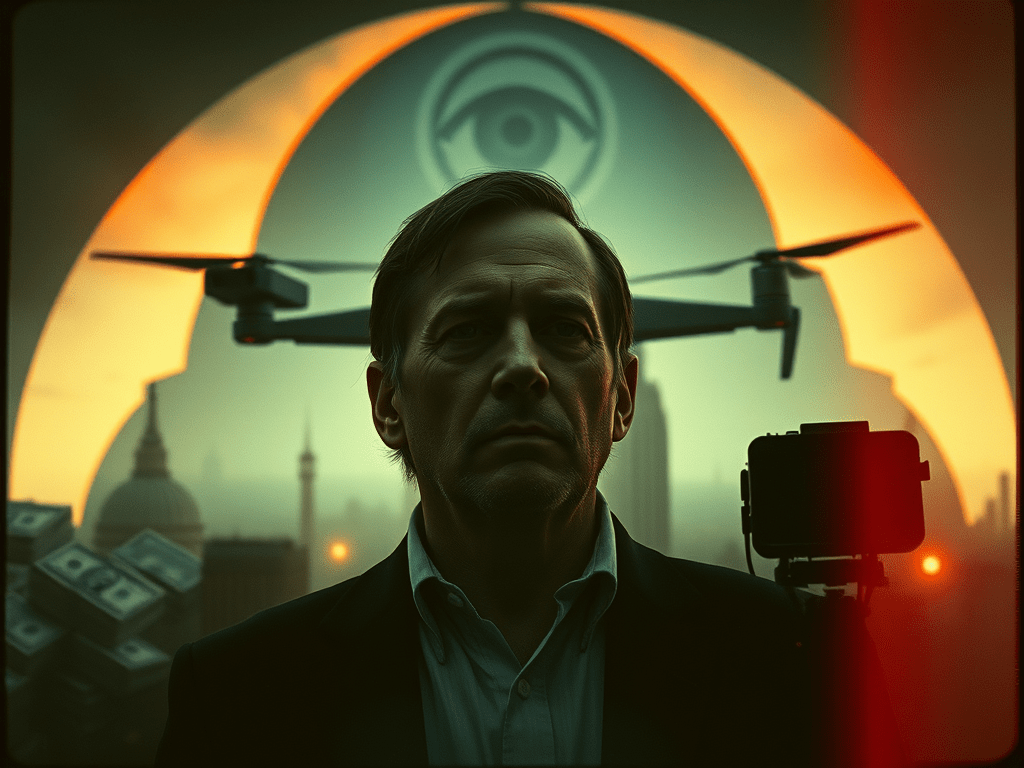
If MK-Rogan is the friendly podcast skin over billionaire psychosis, then Peter Thiel is the kernel.
Rogan sells you the vibe that these guys are just “interesting, controversial thinkers.” Thiel is one of the people quietly specifying the operating system: what counts as danger, who counts as an enemy, which futures are “allowed,” and who gets left outside the lifeboat.
This is about the power a potentially self-deluded predator can “naturally” acquire in a world whose core-engine runs on human suffering.
Thiel is just one of the cleanest case studies we have of a 21st century archetype:
Tech-gnostic billionaire, obsessed with apocalypse, building surveillance and defense infrastructure while preaching “freedom” from democracy.
Once you see the pattern, you start noticing how many “MK-ROGAN” moments are actually “MK-THIEL” effects downstream.
1. Thiel 101: From PayPal to Political Theology
Quick sketch:
- Co-founds PayPal, cashes out into billionaire status.
- Uses that money to:
- build Palantir, the data-fusion / surveillance contractor now wired into U.S. and allied intelligence, policing, health data and military systems, often with CIA-adjacent backing. (Wikipedia)
- fund Founders Fund and a whole web of right-leaning tech, defense, and ideology projects.
- flirt with seasteading and other “exit from democracy” fantasies. (Al Habtoor Research Centre)
He literally wrote a 2009 essay titled The Education of a Libertarian where he says, in plain text:
“I no longer believe that freedom and democracy are compatible.”
That’s not a paraphrase. (Cato Unbound)
Then, years later, you get the neat Atlantic summary:
Thiel “taking a break from democracy” while pouring money into candidates and projects that weaken it or route around it. (The Atlantic)
So from the start, his project is antithetical to “make democracy better.”
IE:
Use tech + money to escape the constraints of ordinary people having a say.
If MK-ROGAN is about normalizing billionaires to the masses, MK-THIEL is about normalizing the idea that the masses are the problem.
2. The Antichrist Fixation: Theology as UX for Power
Over the last couple of years, Thiel has gone loudly weird in public about religion and the Antichrist [see: Peter Thiel And The Antichrist Of Techno-Feudalism – Gnosis Under Fire].
- New Republic: documents him ramping up apocalyptic rhetoric and weaving Antichrist talk into culture-war politics. (The New Republic)
- Guardian: reports on off-the-record lectures where he’s workshopping end-times and Antichrist themes with select audiences. (The Guardian)
- Wired: traces his fixation back to exposure to Carl Schmitt’s political-theological end-times thinking in the 90s. (WIRED)
- Le Monde: notes that, in his framing, the “Antichrist” can be anyone who tries to constrain tech or slow “progress” – including climate activists and regulators – in the name of peace and safety. (Le Monde.fr)
- Theology commentators point out that in early Christian texts, “antichrists” are worldly power figures opposed to spiritual life, not Marvel supervillains, and that Thiel is doing some… creative remixing here. (ARC: Religion, Politics, Et Cetera)
This isn’t just quirky nerd-Catholic stuff. Functionally, it does a few very useful things:
- Binary world split
- On one side: “Katechon” forces – those who hold chaos at bay. Thiel explicitly leans on this concept of a force restraining apocalypse. (conversationswithtyler.com)
- On the other: “Antichrist” forces – anyone advocating brakes, constraints, or global cooperation that might slow his preferred form of techno-acceleration.
- Sacralizing his side’s power
If you are confused and traumatized by decades of Elite-level abuse of your own ability to perceive reality-in-itself, and: - Buy his framing,
- then:
- His companies are not just businesses.
- They’re part of a cosmic effort to “save” civilization from collapse, communism, global governance, whatever the villain of the week is.
- Demonizing constraint
Climate agreements, AI regulation, democratic oversight, unions, public interest law – all become potential avatars of “the Antichrist” in his narrative.
From an ontological-math / systems angle, what he’s doing is narrowing the parameter space:
reduce the number of “legitimate” futures to “accelerate with my friends’ tech stack” or “side with the forces of the Antichrist.”
That is theology taken to narcissitic and psychopathic conclusions,
product positioning with a Book of Revelation skin.
3. The Eye of Saur-err, I mean: Palantir: The Data Cathedral
Now look at where his money and energy went:
- Palantir started as a CIA-funded data-fusion tool, pitched as a way to aid analysts in the War on Terror; it now links vast government and corporate data sources. (Wikipedia)
- It has been used for:
- predictive policing and criminal intelligence in U.S. cities, including controversial deployments that worsened over-policing. (The Guardian)
- ICE immigration systems like Investigative Case Management and now ImmigrationOS, explicitly designed to help identify, track, and deport people at scale. (American Immigration Council)
- a huge range of military, health, and infrastructure contracts across the U.S., UK, and Europe, boosted by a “revolving door” between Palantir executives and government roles, plus heavy lobbying. (Financial Times)
So while Thiel talks publicly about Antichrists and end times, his flagship company:
- hoovers up data,
- integrates it into “god mode” (what a fool he must be) dashboards for states and corporations,
- and increasingly plugs into border regimes, deportation programs, and military modernisation.
Political scientist Asma Mhalla’s read is brutally clear:
Thiel embeds AI in a worldview where conflict and permanent state of emergency are not bugs, but virtues. (Le Monde.fr)
War, crisis, migration, pandemics – all become justification to expand and entrench the infrastructure his world needs:
ubiquitous data fusion, militarized AI, and a public that believes “in an emergency, you don’t question the people with dashboards.”
IE [paraphrasing]:
“I have been granted white-rich-person status, and you shouldn’t question the authority that even I obviously cannot understand to any kind of certainty level. Therefore, I will act as if I am already in control in order to convince those that can easily overthrow my authority that they shouldn’t even try…”
Again, structurally:
Apocalypse talk upstream,
Surveillance and control infrastructure downstream.
4. Weaponized “Freedom”: Democracy for Me, Not for Thee
Thiel’s official branding is “libertarian,” but his own writing and actions push him into a weirder quadrant:
- In The Education of a Libertarian he:
- describes a “race” (no, you’re not crazy if his usage of that word is sus as fuck) between politics and technology where the goal is to minimize politics.
- explicitly says he no longer believes freedom and democracy are compatible. (Cato Unbound)
- He funded seasteading and “exit” projects meant to create zones outside of democratic control. (Al Habtoor Research Centre)
- He’s poured money into candidates and movements hostile to voting rights, worker power, and egalitarian policy. (More Perfect Union)
Tech critic Stephen Diehl sums up the ideological core like this:
Thiel believes the West is in decline due to nihilism and progressivism, and that the answer is a right-wing religious revival + hierarchical political order + tech acceleration under “heroic” individuals. (stephendiehl.com)
So the “freedom” he’s defending is:
- Freedom for capital and code to move without democratic interference.
- Freedom for billionaire decision-makers to reshape institutions.
- Not freedom for:
- workers,
- migrants,
- protestors,
- climate activists,
- people who hold belief systems that aren’t in service to the psychopathic exploitation of human brains and bodies.
- or anyone who might slow the machine down.
In other words:
Libertarian at the top, authoritarian at the bottom.
From a political-theology perspective, it’s straight-up Schmittian:
- Sovereign is the one who decides the exception.
- In his imagination, the “sovereigns” are the tech-capitalist katechon figures, “holding chaos [individual sovereignty and freedom] at bay.”
- The demos are, at best, a problem to be managed and monetized, if at all possible.
5. The War Stack: Drones, Borders, Special Ops Tech, and Machine-Learned Genocide
Look at where his investment patterns converge:
- Palantir: data fusion for war, policing, immigration control. (Wikipedia)
- Anduril: AI-powered defense tech, autonomous surveillance towers, “smart” [according to intellectual children] border walls. (Barron’s)
- Quantum Systems: dual-use drone company kitted out for modern warfare, boasting tight integration of software and hardware – with Thiel capital involved. (Barron’s)
Plus the ever-deeper lobbying and revolving-door presence inside U.S. and UK security establishments. (Financial Times)
So while the public face might be “visionary investor” talking about AI and the future, the concrete outcomes are:
- More autonomous weapons platforms.
- More integrated border and deportation systems.
- More AI-mediated “situational awareness” for states, cops, and militaries.
- A political “discourse” that treats all that as natural, inevitable, and morally necessary.
Combine that with the Antichrist narrative and you get a very specific moral geometry:
Any attempt to demilitarize, slow down, regulate, or democratize this stack
= suspicious, maybe “Antichrist” aligned.
Any move to deepen it
= “defense of civilization.”
That is Peter Thiel’s “business model” – full-fucking-stop.
6. MK-THIEL as Archetype: How Billionaire Eschatology Becomes Culture
If MK-ROGAN is your “buddy” telling you these “guys” are just “misunderstood geniuses,” then:
MK-THIEL is the archetype behind a whole class of people:
- Rich enough to think in civilizational terms.
- Traumatized or resentful enough to believe most humans can’t be trusted with power.
- Religious or myth-literate enough to wrap their portfolio in eschatology.
- Cynical and fundamentally uneducated enough to call that “realism.”
A few key patterns in that archetype:
- Democracy is framed as naive.
Voting, public bargaining, unions, multilateral institutions – all get painted as “slow, dumb, sentimental.“ - Tech is framed as destiny, despite the human cost at all intellectual strata.
They perceive their abusive, financial power over engineers as “convincing enough” of their own “merit” (read: Divine Authority, ha-ha), such that they [Thiel-types] believe that: - They are the natural continuation of evolution, God’s will, or “history.”
- Emergency is normalized.
Crisis is permanent: terrorism, migration, pandemics, great power competition, AI risk, civilizational decline. This justifies the constant expansion of the war stack. - Dissent is pathologized or demonized.
Critics are:- “woke,”
- “nihilists,”
- “globalist stooges,”
- or, in the “upgraded language” of deluded psychopaths like Thiel – who scare people so naturally into compliance that they are convinced they are worth a damn because of physical intimidation alone [IE they feel like predators] – “Antichrist” energies aren’t people trying to collectively reduce their unjust suffering, but flawed logic by human beings who are seen as nothing other than slave nodes in a Master-Slave computer system.
From an ontological-math angle, what he’s doing is:
- collapsing the space of possible futures to a narrow basin of attraction where:
- tech acceleration,
- militarized infrastructure,
- and billionaire steering
become the only “rational” options.
If you can get enough people, especially enough mid-level technocrats and media figures, to internalize that basin as “common sense,” you’ve basically hacked reality generation.
7. From MK-ROGAN to MK-THIEL: The Arrogant-Douchebag-Narcissist Pipeline
Now plug this back into the MK-ROGAN thesis.
Rogan’s arc goes something like:
- Early days: working-class stories, fringe weirdos, artists, fighters – chaos and curiosity.
- Gradual shift: more billionaires, tech moguls, spooks, “futurists,” culture-war philosophers.
- Net effect: normalize billionaire worldviews inside an audience that once saw itself as outside of elite power.
So structurally:
- MK-THIEL layer
- Design the worldview:
- democracy is obsolete,
- tech war is destiny,
- billionaires = katechon,
- constraint = Antichrist.
- Build the infrastructure:
- Palantir, Anduril, drones, border AI, lobbying networks.
- Design the worldview:
- MK-ROGAN layer
- Wrap that worldview in:
- podcasts,
- plausible deniability,
- “I’m just asking questions,”
- weed and MMA and bro-banter.
- Let people feel like they’re rebelling while they internalize the billionaire eschatology.
- Wrap that worldview in:
- Audience layer
- Millions of people who:
- are legitimately pissed off at institutions,
- don’t have time to read Schmitt or political theology,
- and are desperate for someone who sounds confident.
- Millions of people who:
They don’t wake up one day and say “I support tech-gnostic Schmittian authoritarianism.”
They slowly slide into:
- hating “globalists,”
- seeing militarized borders as common sense,
- treating AI war stacks as inevitable,
- and defending billionaires as misunderstood prophets.
That’s MK-THIEL working through MK-ROGAN.
8. Simple Wisdom: How Not to Get Drafted Into Someone Else’s Apocalypse
“Simple wisdom” to help people, especially working-class and neurodivergent folks, to avoid getting sucked into this.
So here’s the cheat sheet.
When someone talks like Thiel or his ecosystem, watch for:
- “Freedom vs democracy” as a zero-sum game.
If they’re comfortable saying, or implying, that democracy has to shrink so freedom can grow, ask: “Freedom for who? To do what? To whom?” - Permanent emergency.
If every issue is framed as:- existential,
- end-times,
- “never-before-seen” crisis,
that’s a tell. Emergency talk is often a permission slip to silence debate.
- Theology-flavored branding.
Once people start talking about:- Antichrist,
- katechon,
- holy missions,
- civilization saviors,
in the same breath as their companies and investments, you’re not just in a policy discussion. You’re sitting in someone’s private religion, being gently recruited.
- Surveillance and weapons wrapped in “innovation.”
Any time someone:- builds tools for ICE, predictive policing, border walls, or autonomous weapons, (American Immigration Council)
- and then calls it a neutral contribution to “efficiency” or “security,”
assume they’re at least partially bullshitting you.
- “The people” as the problem.
If the baseline assumption is:- voters are too dumb,
- publics are irrational,
- only a select few can really see what’s happening,
then you’re dealing with someone who wants sovereignty without accountability.
None of this means you have to become an anti-tech hermit, just:
Don’t let someone else’s eschatology hijack your sense of what’s possible.
You’re allowed to like AI, games, space tech, and weird philosophy without signing up for:
- data cathedrals,
- “permanent” war footing,
- and a future designed by guys who want to “take a break from democracy.”
MK-THIEL is a warning label slapped on an entire class of operators:
When a billionaire starts telling you who the Antichrist is,
check their contract list, not their scripture.
-BoloSolo out…
PS: Stay sovereign.
Sources
- N. Catic, “What’s Up With Peter Thiel’s Obsession With the Antichrist?”, The New Republic, Sep 16, 2025. (The New Republic)
- J. Bhuiyan et al., “Inside tech billionaire Peter Thiel’s off-the-record lectures about the antichrist,” The Guardian, Oct 10, 2025. (The Guardian)
- G. Greenberg, “The Real Stakes, and Real Story, of Peter Thiel’s Antichrist Obsession,” Wired, Sep 30, 2025. (WIRED)
- C. Lesnes, “‘According to Peter Thiel, the 21st-century Antichrist uses fear of climate change’,” Le Monde, Oct 30, 2025. (Le Monde.fr)
- A. Kotsko, “Peter Thiel’s Surprisingly Simple Antichrist,” Arc, Nov 19, 2025. (ARC: Religion, Politics, Et Cetera)
- P. Thiel, “The Education of a Libertarian,” Cato Unbound, Apr 13, 2009. (Cato Unbound)
- R. Draper, “Peter Thiel Is Taking a Break From Democracy,” The Atlantic, Nov 9, 2023. (The Atlantic)
- S. Diehl, “Deconstructing the Worldview of Peter Thiel,” personal blog, Feb 1, 2023. (stephendiehl.com)
- “Palantir Technologies,” Wikipedia entry, accessed Dec 2025. (Wikipedia)
- J. Peretti, “Palantir: the ‘special ops’ tech giant that wields as much real-world power as Google,” The Guardian, Jul 30, 2017. (The Guardian)
- “Palantir Knows Everything About You,” Bloomberg Businessweek, Apr 19, 2018. (Bloomberg)
- “ICE to Use ImmigrationOS by Palantir, a New AI System to Track Immigrants,” American Immigration Council, Aug 21, 2025. (American Immigration Council)
- C. Timberg, “How Palantir shifted course to play key role in ICE deportations,” The Washington Post, Dec 3, 2025. (The Washington Post)
- “Palantir’s ‘revolving door’ with government spurs huge growth,” Financial Times, Feb 2025. (Financial Times)
- “Peter Thiel: The Billionaire Buying the End of Democracy,” More Perfect Union, Nov 14, 2022. (More Perfect Union)
- A. Mhalla, “Peter Thiel embeds AI in a worldview where conflict and the state of emergency become virtues,” Le Monde, Dec 7, 2025. (Le Monde.fr)
- “Seasteading: Radical Vision or Dystopian Future?”, Habtoor Research, Sep 22, 2025. (Al Habtoor Research Centre)
- “Peter Thiel on Political Theology (Ep. 210),” Conversations with Tyler, Apr 17, 2024. (conversationswithtyler.com)
- “This Peter Thiel-Backed Start-Up Triples Valuation to $3.5 Billion,” Barron’s, Nov 2025 (Quantum Systems / defense drones). (Barron’s)
 Gnosis Under Fire
Leave a comment