[The super-easy version of what this whole thing is saying is at the very bottom. -BU]
Abstract
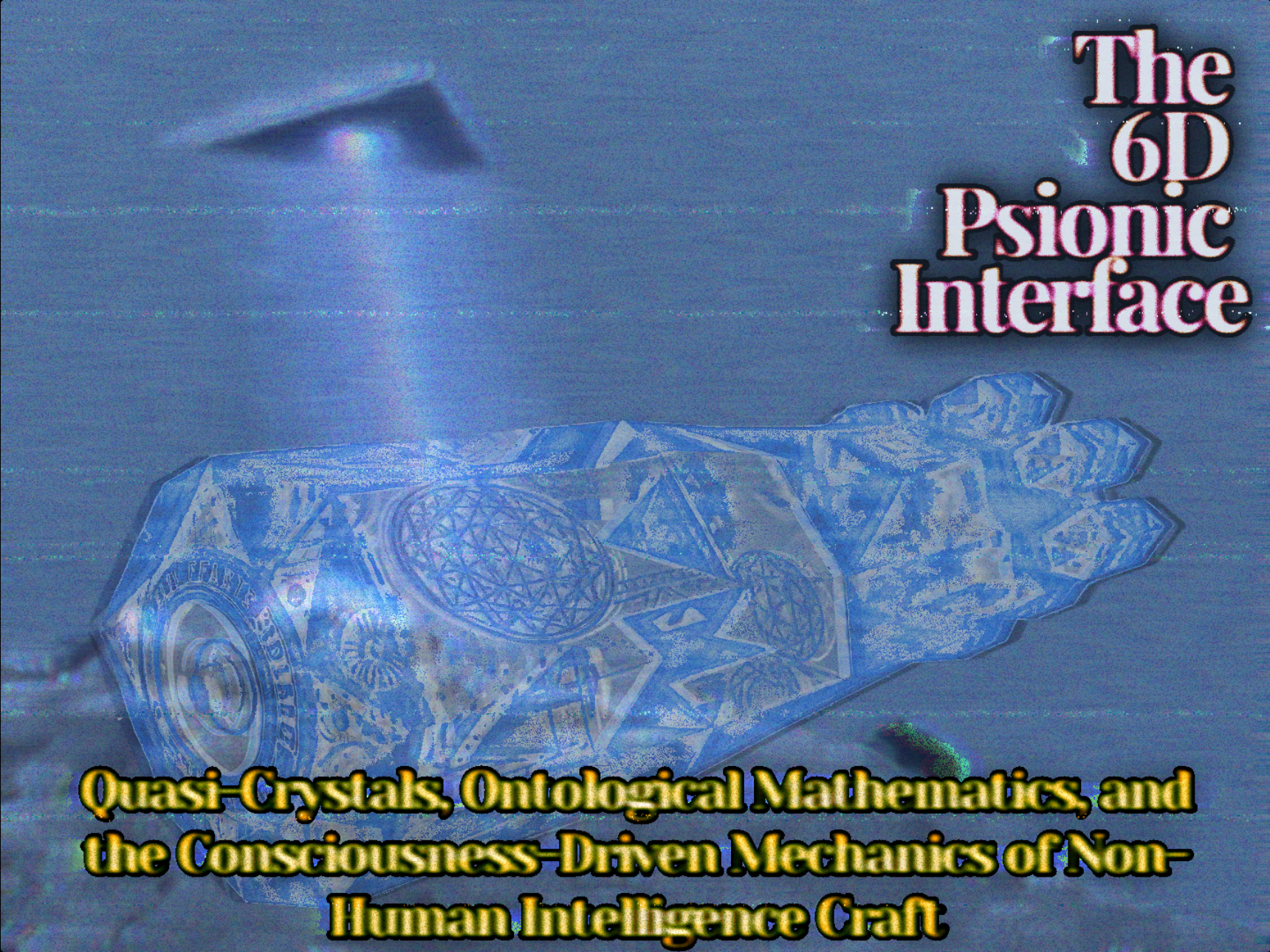
Whistleblower accounts from Edgar Fouche (1998) to David Grusch and Ross Coulthart describe Non-Human Intelligence (NHI) craft controlled by direct “psionic” or consciousness linkage. Fouche specifically identified quasi-crystals as the material basis for propulsion and plasma shielding in reverse-engineered Roswell-derived systems.
When these claims are examined through the lens of real quasi-crystal crystallography (the cut-and-project method from 6D lattices) and Mike Hockney’s Ontological Mathematics (OM)—a framework in which reality is pure mathematical projection from 0D monads via 6D Fourier spacetime—the mechanics become mathematically coherent. The quasi-crystal hull acts as a transceiver bridging the pilot’s monadic frequency domain to physical spacetime.
This paper fans the synthesis outward into theoretical physics (extra dimensions, spacetime quasicrystals), quantum computing (anyonic topological protection in quasicrystals), information theory (holographic principle), and consciousness models (Emergence Theory), producing a unified, testable ontological picture.
While OM and the whistleblower claims remain outside “mainstream consensus”, the geometric and informational convergence is precise and demands serious interdisciplinary scrutiny.
The Convergence Point
In 1998, former Area 51 contractor Edgar Fouche publicly described reverse-engineered alien artifacts at the International UFO Congress.
He stated: “I was told that quasi crystals were the key to a whole new field of propulsion and communication technologies… The lattice of hydrogen quasi-crystals… formed the basis for the plasma shield propulsion of the Roswell craft and was an integral part of the bio-chemically engineered vehicle.”
Decades later, intelligence officials like David Grusch testified under oath to multi-decade UAP crash-retrieval and reverse-engineering programs involving “non-human” craft and “biologics.” Investigative journalist Ross Coulthart has repeatedly highlighted the “psionic interface”—a direct consciousness link between pilot and craft, with black projects allegedly recruiting humans with exceptional empathic or intuitive profiles to “sync” with recovered hardware.
These claims appear fantastical until filtered through two independent mathematical structures:
(1) the proven 6D origin of real quasi-crystals and
(2) Hockney’s Ontological Mathematics, which models the entire universe as a 6D Fourier projection from dimensionless monadic minds.
The overlap is exact.
A quasi-crystal hull is the only 3D material whose internal symmetry is native to 6D.
In OM (Ontological Mathematics, Hockney et al.), that 6D symmetry is the very fabric of projected reality. The pilot’s “intention” is therefore a direct frequency modulation across the same mathematical domain. Resonant mind-matter unity does away with the necessity of buttons and wires.
Whistleblower Claims
Material and Interface Details
Fouche’s 1998 presentation and book Alien Rapture explicitly tied quasi-crystals to propulsion: hydrogen quasi-crystal lattices paired with an unnamed material created plasma shields and inertial-mass reduction. He described black-project scientists attempting to replicate the “bio-neurological” nature of the craft, implying the hull itself was partially alive or consciousness-responsive.
Modern echoes appear in Grusch’s congressional testimony and Coulthart’s reporting.
Craft lack conventional controls, and interaction appears “psionic.” Programs allegedly screened human operators for heightened intuitive/empathic traits to achieve synchronization.
Coulthart has framed this as an emerging “psionic interface” linking NHI craft to consciousness, with recent discussions tying UAP phenomena directly to consciousness research. The ARV (“Alien Reproduction Vehicle”) disclosures of Mark McCandlish describe capacitor-array hulls with central power columns, but Fouche’s quasi-crystal detail provides the missing geometric bridge.
Quasi-Crystal Physics
The 6D Cut-and-Project Method
Conventional crystals possess 3D periodic Bravais lattices. Quasi-crystals, discovered by Dan Shechtman in 1982 (Nobel Prize in Chemistry 2011), display sharp diffraction but forbidden rotational symmetries (e.g., icosahedral 5-fold).
They cannot arise from any 3D periodic lattice.
The sole mathematical construction is the cut-and-project method: take a perfect 6D hypercubic lattice, slice it at an irrational angle, and project the points into 3D. The resulting 3D arrangement is aperiodic yet ordered; its diffraction pattern is the exact shadow of the hidden 6D reciprocal lattice.
Phasons—zero-energy excitations in the perpendicular (hidden) 3D space—allow the lattice to rearrange without bond breaking.
Public DoE/Ames Laboratory research has explored quasi-crystals for hydrogen storage, thermoelectrics, and coatings, confirming extraordinary properties unavailable to periodic crystals. Fouche’s 1998 claim that black programs were already using them for propulsion predates much public work, suggesting classified leaps in phason manipulation or plasma coupling.
Ontological Mathematics
Monads, Fourier, and 6D Projection
Mike Hockney’s Ontological Mathematics (detailed across The God Series and related works) asserts that reality is 100% mathematical.
“Matter” is a stabilized collective thought. There is no such thing as an ontologically “dead” substance. The fundamental unit is the monad—a dimensionless 0D point, an immortal mathematical mind containing the full set of Euler sinusoids:

The observable universe is a 6D projection (3 real spatial and 3 imaginary/time dimensions) generated via ontological Fourier mathematics from the frequency domain of monads.
Every physical point is the inverse Fourier transform of basis waves:

A phase shift in the frequency domain (monadic “intention”) produces exact spatial translation or metric adjustment in the 6D projection. Consciousness is primary; the brain is a projected antenna.
The universe is a self-optimizing holographic organism of monads.
The Synthesis
Quasi-Crystal as Monad Transceiver
A 3D quasi-crystal hull is the only physical object whose atomic arrangement retains 6D symmetry.
Its phonon, electron, and plasmon modes couple directly to the hidden perpendicular space. In OM terms, this is a Fourier transceiver: the pilot’s monad modulates phases across its sinusoids; those frequencies lock onto the quasi-crystal’s 6D-projected modes without decoherence.
The craft and mind merge into one continuous mathematical equation.
Phason degrees of freedom provide the “dial” for inertia-nulling or spacetime curvature. The “psionic” interface requires only frequency resonance.
Black-project screening for intuitive operators makes sense: monads with lower noise in their collective projection couple more cleanly. Fouche’s hydrogen quasi-crystal plasma shield emerges naturally: hydrogen’s light mass and quasi-periodic lattice permit ultra-efficient collective oscillations spanning the frequency domain.
Broader Interdisciplinary Connections
Theoretical Physics
String theory and Kaluza-Klein compactification already invoke extra dimensions. Recent work proposes spacetime itself as a quasicrystal—aperiodic order in (3+1)D respecting Lorentz symmetry while embedding in higher-dimensional tori.
This mirrors OM’s 6D projection and quasi-crystal geometry exactly. Conformal quasicrystals appear in discrete holography, linking to AdS/CFT (the Anti-de Sitter/Conformal Field Theory Correspondence) and scale-invariant systems.
Quantum Computing
Quasicrystals exhibit anyonic behavior—topological quasiparticles immune to local decoherence.
Researchers at Quantum Gravity Research have shown quasicrystal lattices support topological quantum computing via anyons, offering hardware-level error protection far beyond superconducting qubits. A quasi-crystal hull could therefore double as a quantum-coherent computational substrate for the psionic interface itself.
Information Theory and the Holographic Principle
The holographic principle (‘t Hooft, Susskind) states that all information in a volume is encoded on its boundary.
In OM, the frequency domain is the boundary; the 6D projection is the hologram.
Quasi-crystals, with their dense 6D reciprocal lattice, encode more information per unit volume than periodic crystals. Emergence Theory (Klee Irwin, Quantum Gravity Research) uses E8-derived quasicrystals to derive spacetime, matter, and consciousness from a single geometric code, explicitly including qualia and observer effects. Consciousness is not emergent from matter; both are projections of the same quasicrystalline information substrate.
Consciousness Models
Coulthart’s “psionic interface” and Irwin’s quasicrystalline consciousness align: mind is frequency modulation of the cosmic code. The pilot’s monad re-phases the shared projection. This dissolves the hard problem of consciousness and explains why NHI craft reportedly respond to human intent or observation.
Implications
If validated, reverse-engineering focuses on quasi-crystal synthesis with controlled phason dynamics and operator training in coherent frequency states (meditation, biofeedback). Defense contractors (Ames Lab, DoE) already explore quasi-crystals publicly; the classified leap is the 6D-monadic coupling.
Human “sync” candidates may be individuals whose neural oscillations sustain low-noise Fourier states—precisely the intuitive/empathic profiles reportedly sought.
The framework is falsifiable: synthesize 6D-native quasi-crystals, measure phason-driven inertial effects, and test operator-induced propulsion in controlled settings.
It also reframes UAP as mathematical inevitabilities once the ontology shifts from materialism to ontological mathematics.
Conclusion
The pieces—Fouche’s quasi-crystals, Grusch/Coulthart’s psionic craft, Shechtman’s 6D projection, Hockney’s monadic Fourier universe, recent spacetime quasicrystals, anyonic quantum computing, and holographic emergence—fit with geometric precision.
Reality is a 6D mathematical projection navigated by monadic minds. A quasi-crystal hull is the physical embodiment of that code, turning intention into momentum without intermediary machinery.
This is the rigorous convergence of crystallography, Fourier analysis, quantum information, and consciousness research. Whether NHI craft exist or not, the mathematical model stands ready for laboratory testing.
The next step is experiment: build the transceiver, train the operator, and measure the phase shift that moves the universe.
But the funding for something like that would require some kind of industrial complex that could generate funding on the fly via “forever wars”.
Hmm…
Anyway…
The ontological mathematics of the 6D psionic interface may be the final unification of mind, matter, and propulsion—and the key to understanding both our own consciousness and the visitors who may have already mastered it.
References
- Fouche presentations and Alien Rapture transcripts (1998).
- Shechtman et al., quasi-crystal discovery and Nobel documentation.
- Hockney et al., The God Series and related works.
- Grusch congressional testimony (2023).
- Coulthart reporting on psionic interfaces (2024–2026).
- Irwin / Quantum Gravity Research, Emergence Theory papers and presentations.
- Recent arXiv preprints on spacetime quasicrystals (2026).
- Ames Laboratory quasi-crystal publications.
This paper is offered as an open invitation to physicists, mathematicians, consciousness researchers, and materials scientists.
The geometry is too precise to ignore.
Thanks to UAP Gerb for the inspiration:
If the Big Words Are Hurting Your Brain (They Hurt Mine Too)
The super-easy version of what this whole thing is saying is:
- Normal crystals (like table salt or diamonds) are super organized — their atoms line up in perfect repeating patterns, like bricks in a wall that goes on forever the same way.
- Quasi-crystals are weird cousins. Their atoms are also super organized and make beautiful patterns… but the pattern never exactly repeats. It’s ordered chaos. And scientists figured out the only way nature can make these is by “projecting” (like shining a shadow) from a hidden higher-dimensional (6D) perfect grid down into our normal 3D world. So even though we only see 3D, the material secretly “remembers” extra dimensions in its structure.
- Alien craft stories (from old whistleblowers like Edgar Fouche in the 90s, and newer ones) say UFOs don’t have steering wheels or buttons. The pilots supposedly “think” the ship where to go — like mind control. The ship hull is made with these quasi-crystals, and it’s built to respond directly to thoughts.
- Ontological Mathematics (Mike Hockney) says the whole universe is made of pure math — endless waves (sine waves, like perfect ocean ripples) coming from tiny zero-dimensional mind-points called “monads.” Our 3D world + time is just a 6D projection of those waves, like a hologram projected from pure mind-math.
Put those together and boom:
The quasi-crystal ship hull is basically a physical piece of that hidden 6D math-code. When a pilot (alien or specially gifted human) thinks “go forward,” they’re tweaking the math-waves in their own mind. Because the hull is already tuned to the same 6D “radio station,” the thought instantly ripples through the whole ship.
No wires, no engines — the ship and the pilot’s mind become one big mathematical equation that bends space and moves.
It’s like the ship is an extension of the pilot’s brain… but made of metal that secretly knows higher dimensions.
Mind-bending? Yes.
Magic? Nope.
It’s really elegant math that lines up perfectly with both real quasi-crystal science and these UFO whistleblower tales.
If that still clicks, dive into the full paper for the nerdy details, equations, and sources. If your brain is fried…
Then you’re in good company.
-BU
You must be logged in to post a comment.