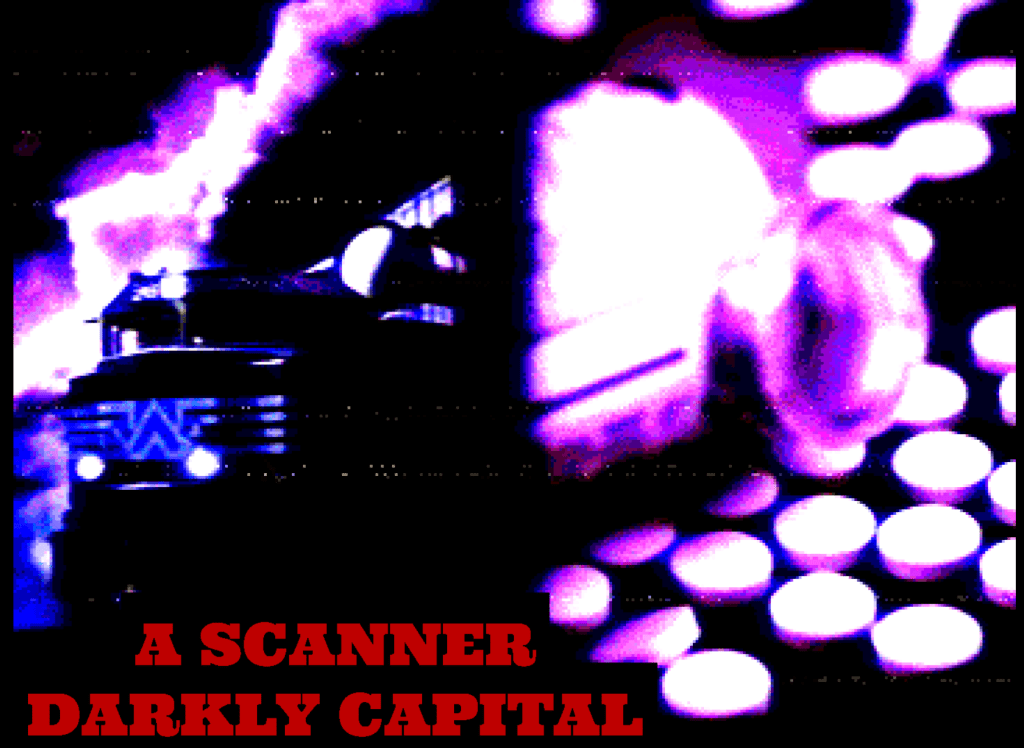
A Scanner Darkly
Capital
Transports vinyl chloride, industrial chemicals, and consumer goods via rail.
Stock: $303/share | Dividend: 1.8% | “Chugging to new all-time high”[^24^]
38 cars derail. Controlled burn releases phosgene gas. Aquatic life dies. Residents report rashes, respiratory failure.
Externalities: Uninsured | Q3 Earnings: Beat by $0.46/share[^24^]
Develops VYKAT XR for hyperphagia (insatiable hunger) and metabolic disorders linked to chemical exposure/genetic damage.
Side Effects: 8% discontinuation rate, cardiac events, death[^1^]
Walgreens (8.60% cap rate) and Dollar General (6.75%) serve as distribution nodes for both toxins and treatments.
NNN Lease: “Essential Retail” | Sale-Leaseback: Active[^16^]
When side effects crash stock (SLNO -26%), lawyers monetize the volatility. When railroads boom (NSC +50%), hedge funds buy.
Hedge Fund Inflow: $1.8M-$180M (depending on URL inflation)[^1^][^24^]
Profits buy more rail capacity. More chemicals ship. More illness. More drugs. More retail. More litigation. [REPEAT]
NORFOLK, VIRGINIA — In Philip K. Dick’s A Scanner Darkly, the drug Substance D doesn’t just addict its users; it splits their brains into two warring hemispheres until they can no longer recognize themselves. The left hand doesn’t know what the right hand is doing, yet both are clutching the same pipe.
Welcome to the Norfolk Southern Loop, where the left hand derails vinyl chloride into the Ohio River while the right hand writes a prescription for the nausea. Where the railroad that poisons the water supply is trading at all-time highs while the lawyers sue the drug company that treats the poisoning, and nobody—not the institutional investors, not the REIT managers, not the “Neo Ivy Capital Management” algorithm—can see the complete circuit because to see it would be to recognize oneself as the parasite.
The Split-Brain Corporation
Norfolk Southern Corporation (NSC) is currently the belle of the ball. Trading at $303.02 with a market cap of $68.05 billion, the railroad just beat earnings estimates by $0.46 per share[^24^]. Institutional investors—75.10% of the float—are piling in. The dividend yields 1.8%, paid quarterly like clockwork, funded by the transportation of chemicals, consumer goods, and the invisible effluvia of American production.
But Norfolk Southern has a secret twin. In February 2023, a train carrying vinyl chloride (used to make PVC) derailed in East Palestine, Ohio. The subsequent controlled burn created a phosgene gas cloud visible from space. Fish died in the creeks. Dogs coughed blood. Humans developed “chemical pneumonia.”
The company paid $1 billion in settlements—chump change against their market cap—and continued “chugging along to a new all-time high”[^24^]. The derailment became a buying opportunity. The toxicity was priced in. The illness was externalized.
The Pharmaceutical Mirror
Enter Soleno Therapeutics (SLNO), the dopamine agonist merchants. Their drug, VYKAT XR, treats hyperphagia—an insatiable hunger that can be caused by genetic disorders, metabolic damage, or (though you’d never read this in the 10-K) chronic low-level chemical exposure.
The drug was approved in March 2025. By November, the company admitted that 8% of patients discontinued due to adverse effects, including cardiac events and at least one death[^1^]. The stock crashed 26%. The victims—pediatric patients with Prader-Willi syndrome—became “discontinuation rates.” The death became a “serious adverse event” in the FDA’s database, a data point indistinguishable from the statistical noise.
But here is the Scanner Darkly moment: The same institutional investors shorting Soleno on the way down were likely long Norfolk Southern on the way up. The chemical spill creates the market for the cure. The cure creates the side effects. The side effects create the litigation. The litigation creates the volatility. The volatility creates the alpha.
Everybody wins. Except the biology.
The Retail Nodes
Where does the cycle touch ground? In the net lease properties of The Boulder Group’s Q1 2026 report[^16^].
Walgreens—trading at distressed 8.60-9.00% cap rates because they’re closing stores—sells both the industrial solvents (cleaning products, pesticides) that contaminate watersheds and the prescriptions that treat the resulting endocrine disruption. Dollar General—6.75% cap rate—sells the processed foods that accelerate the metabolic damage, in food deserts created by the same economic extraction that makes Norfolk Southern’s rail lines profitable.
These aren’t stores. They’re metabolic processing stations in the human supply chain. The “passive income” generated by these NNN leases is literally the rent paid by corporations who have externalized every cost onto the biological substrate. The landlord in Boca Raton collecting checks from the Norfolk Walgreens doesn’t see the chemical burns. He sees a “stable tenant profile”.
The Handlers
In Dick’s novel, the police handlers wear scramble suits to hide their identities, constantly shifting identities to prevent addiction or recognition. In our version, the handlers wear Patagonia vests and operate out of Chicago (The Boulder Group), San Diego (Robbins Geller), and wherever Neo Ivy Capital Management hangs its shingle (probably a WeWork in Stamford).
They are the arbitrageurs of the fracture:
Robbins Geller sues Soleno for securities fraud—not because children died, but because the stock dropped[^1^]. They convert biological death into a derivative instrument.
The Boulder Group converts physical retail space into fixed-income instruments, abstracting the human labor and chemical consumption inside into “tenant profiles” and “cap rates”[^16^].
Neo Ivy Capital buys Norfolk Southern at $303, ignoring the vinyl chloride because “The railroads have pricing power”[^24^]. The derailment is already priced in. The cancer is already amortized.
The Recognition
In the final pages of A Scanner Darkly, Bob Arctor—undercover cop turned Substance D casualty—stares at his own police reports, unable to recognize that the criminal he’s hunting is himself. He is both the enforcer and the addict, the surveillor and the surveilled.
We are all Bob Arctor now.
We invest in index funds that hold Norfolk Southern and Soleno simultaneously. We buy the dip on railroads after chemical spills. We celebrate the “essential retail” cap rates at Dollar General while ignoring that the “essential” products are the slow-acting poisons causing the metabolic disorders that require Soleno’s drugs.
The closed loop is complete. The railroad ships the poison. The poison creates the market. The market creates the drug. The drug creates the side effect. The side effect creates the litigation. The litigation creates the volatility. The volatility creates the alpha. The alpha buys more railroad stock.
THE ONLY WITHDRAWAL SYMPTOM IS CONSCIOUSNESS.
THE ONLY CURE IS CAPITAL.
[^1^]: Robbins Geller Rudman & Dowd LLP. “Class Action Lawsuit Against Soleno Therapeutics.” March 6, 2026.
[^16^]: The Boulder Group. “Q1 2026 Net Lease Tenant Profiles Report.” March 2026.
[^24^]: MarketBeat. “Neo Ivy Capital Management Invests in Norfolk Southern Corporation (NSC).” March 7, 2026. (Note: URL claims $180M, filing confirms $1.8M—the Spectacle inflates even as it reports.)
Filed from a booth at The Birch, Colley Avenue, Norfolk, VA. The author is wearing a scramble suit made of 10-K filings and dividend statements. If you see him, don’t recognize him.
 Gnosis Under Fire