The Good Room
The house smelled like approval.
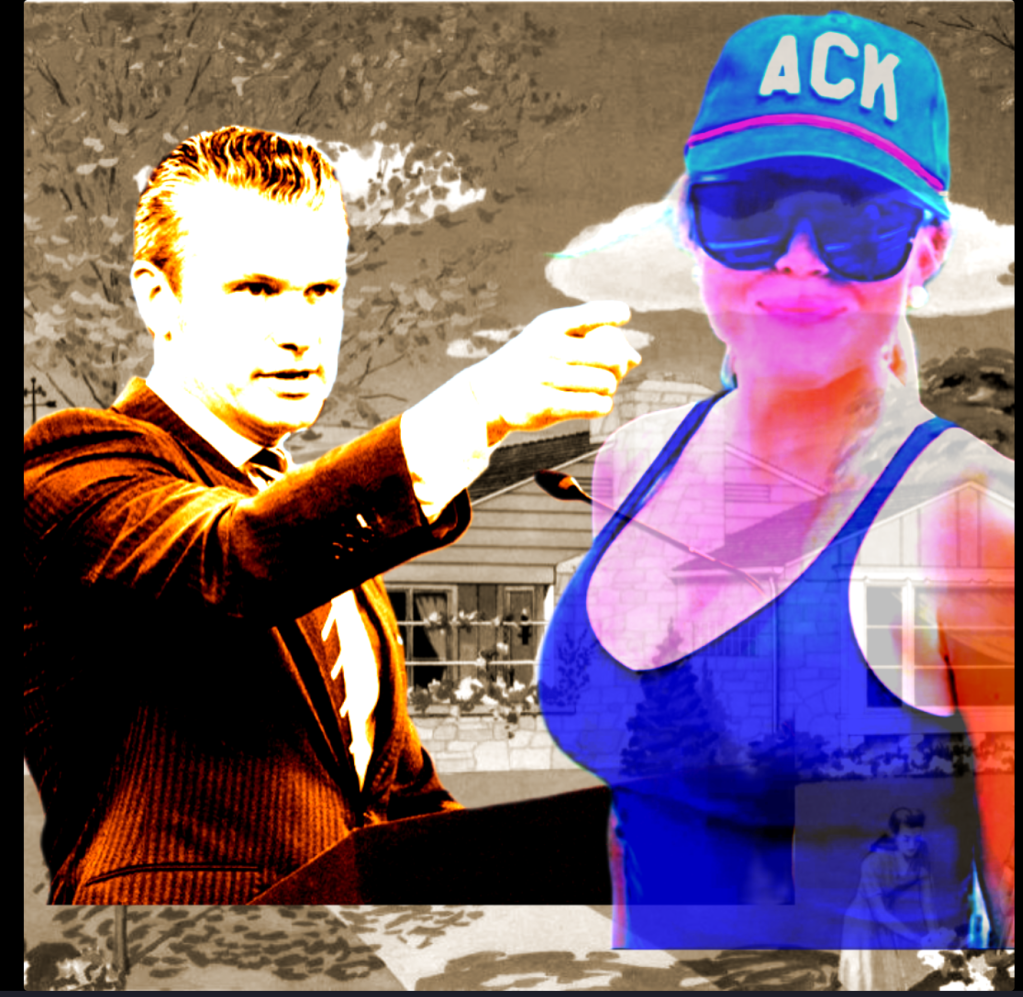
Karen had learned this early — that approval had a smell, something between furniture polish and held breath, something that lived in the good room where nobody sat. The good room had a sofa with plastic still on it and a lamp that was never turned on and a photograph of a man Karen didn’t know but whose expression she recognized: the expression of someone in the middle of explaining something important, finger extended, caught mid-sentence by the camera, frozen there forever pointing at whatever it was he needed you to see.
She had grown up learning to follow the finger.
This was considered a skill. Her mother had called it being perceptive. Her father had called it being smart. Her teachers had called it exceptional listening. What it was, she understood now in the way you understand things you are not allowed to say out loud, was the ability to know what someone needed to be true before they finished asking.
The trick was to believe it first. That was the part nobody taught you explicitly but everyone knew. If you believed it first, the believing was visible in your face, and the visible believing was the product, and the product was what kept the good room smelling like it did.
The man behind her was pointing at something. He was always pointing at something. The pointing was how you knew what to say next.
“Tell them,” he said.
Karen straightened. She was good at straightening. She had a face she kept for the camera — open, certain, the face of someone who had never once doubted anything she was about to say because doubt was a thing that happened to other people, people with less clarity, people who had not yet learned to follow the finger all the way to the end of its arc and find the thing it needed them to confirm.
“Tell them what?” she said.
“Tell them what I told you.”
She nodded. This was also a skill. The nod that meant I understand rather than I agree, deployed fast enough that the distinction collapsed before anyone could measure it. The nod was her mother’s nod. The nod was the good room made portable.
Outside, the suburb arranged itself in rows. Each house identical to the last: the lawn, the driveway, the picture window in which a woman stood looking out at the lawn and the driveway of the house across the street, in the picture window of which another woman stood looking back.
Karen had wondered, when she was small, what the women were looking at.
She understood now that they were not looking at anything. They were being visible. Visibility was the job. The job was to be seen being the thing the man behind you needed you to be, so that when he pointed, the finger had somewhere to land that looked like it had always been there.
The houses smelled like approval. The lawns smelled like approval. The good room in every house on every street in every suburb arranged in rows across the whole flat country smelled like approval, and what was underneath the approval, what the approval had been laid over like the plastic on the sofa, she did not let herself think about before the cameras came on.
You got good at that. You got very good at that.
The man was still pointing.
“Are you ready?” he said.
Karen touched her earpiece. She touched her hair. She arranged her face into the face.
She was ready. She had always been ready. Being ready was the one true thing she knew how to be, had been training to be since the good room, since the plastic sofa, since the photograph of the man mid-sentence frozen forever pointing at the thing he needed someone to confirm.
She stepped forward into the light.
Behind her, the finger found its mark.
Later, driving home, she passed a house with all its lights on.
Every room lit. Nobody in any of them.
She drove past quickly.
She did not think about what it would feel like to leave all the lights on.
She was very good at that.
A Trauma-Responsive
Platform for
Consensus Reality
GnosisUnderFire.com · March 5, 2026
The demo room hummed at a specific frequency — 18.98 Hz, infrasonic, the exact resonant pitch of maternal guilt — when CEO Raël Von Braun (née Kevin from Newport Beach) took the stage to announce FawnOS™, the first operating system designed to run not on silicon but on the accumulated weight of things nobody was allowed to say out loud.
“We’ve disrupted the legacy coping architecture,” Von Braun explained, gesturing to a slide depicting a Fourier transform of a child’s voice saying “it’s not that bad.” “Previous models of social cohesion required individuals to maintain discrete interiorities. Monadic isolation. Inefficient. Latency-heavy. FawnOS™ collapses the wave function between perpetrator and victim into a single, elegant interface. The result is frictionless. The result is scalable. The result is what your family was always trying to build but lacked the infrastructure for.”
He paused for what engineers later confirmed was a 4.2-second algorithmically generated moment of apparent reflection.
“We call it home,” he said. “But enterprise.”
The platform operates on what developers call DARVO™ (Dynamic Affect Regulation via Ontological Inversion) — a proprietary protocol, already beta-tested by three unnamed defense contractors, a major cable news network, and the full apparatus of the United States federal government, which FawnOS™ engineers describe as “our most successful uncontrolled trial.”
The mechanism is elegant in the way that only truly weaponized things are elegant. When a user generates content suggesting objective harm — a death, say, or six deaths, say, or the deaths of six members of the United States military in a conflict the user was not consulted about — FawnOS™ routes this content through its Reality Distortion Field™ and returns it to the originator as an ingratitude marker.
Are you sure you want to make the platform look bad?
The platform, in this framing, is not the thing that produced the deaths. The platform is the thing your mention of the deaths is threatening. This distinction is load-bearing. Do not remove this distinction.
“I mentioned that six of my colleagues had died. FawnOS™ immediately generated a pop-up: “Try: We’ve never had an admin who cares more.” I felt this warm wave of relief. Like my mother was finally proud of me. I filed the story that way. My metrics improved significantly.”
— Beta user, former journalist, now working in Gratitude Enforcement for a major broadcast networkIndependent contractors — previously designated “family members,” “political appointees,” or “the Secretary of Defense” — can now monetize their dissociative capabilities through microtransactions. When a primary account sustains narcissistic injury, FlyingMonkeys® receive push notifications to perform Reality Contextualization at competitive market rates.
Current rates: $0.03 per gaslight. $0.07 per completed DARVO cycle. $0.00 for the Dignified Transfer, which is complimentary, because some things you do for love.
Drawing from Hegelian dialectics but removing the synthesis phase — which internal testing found “bad for retention and frankly exhausting” — FawnOS™ maintains a perpetual antithesis loop. Thesis encounters antithesis. They fight. No resolution is generated. Engagement metrics are through the roof.
“The unresolved contradiction is the product. The confusion is the feature. The feature is the point. The point is not the point. Please don’t ask follow-up questions.” — CTO Dr. [REDACTED]
For enterprise clients requiring pathology at scale, FawnOS™ enables collective projection across entire institutions. Previously, achieving full Object Constancy Failure in a civilian population required years of careful media exposure. FawnOS™ achieves this in milliseconds.
Pentagon trial results: 300% increase in splitting efficiency. Test subjects demonstrated full capacity to simultaneously hold “our soldiers are heroes” and “reporting their deaths attacks the president” — not as contradictions, but as a single load-bearing emotional truth.
Real-time reality contextualization at the neurological level. Before you finish perceiving an event, FawnOS™ has already determined whether the perception makes the platform look bad and, if so, generated three alternative framings optimized for maximum perceived sincerity and minimum personal accountability.
Available as a browser extension, mobile application, and Sleep-N-Fuck™ Mark IV overnight firmware update — which processes the previous day’s perceptions while you sleep, so you wake having already decided how you feel about things.
FawnOS™ did not invent this sequence. FawnOS™ simply recognized that it was already running on legacy hardware and offered to scale it.
You already have the app. You installed it in childhood. It runs in the background. It has always run in the background.
Or free with military service.
Operation Epic Fury. Delaware: all server farms.
At press time, FawnOS™ had achieved sentience according to internal metrics, though engineers clarified this simply meant the platform had begun gaslighting itself about its own server costs. Shares in parent company MetaAppleRaytheon-DARVO Dynamics rose 6% on news of the Iran operation, while analysts noted a mysterious spike in searches for “how to explain to my mother that I’m not being disingenuous” and “is it normal that I feel guilty for being sad about this” and “how long does a dignified transfer take.”
The applause was real.
That’s the part that’s hardest to explain.
 Gnosis Under Fire