Introduction
The United States is once again grappling with a collision of foreign influence and domestic extremism.
In recent years, Russian information operations have repeatedly intersected with modern U.S. right-wing movements – from fringe online cultures to the halls of power – in ways that expose a darker, systemic vulnerability in American democracy.
These intersections are not accidental or one-off events.
As Senate investigators noted, “Russia is waging an information warfare campaign against the U.S. that didn’t start and didn’t end with the 2016 election”.
The Kremlin’s goal has long been broader: to sow discord, corrode trust in institutions, and inflame America’s internal divisions.
Now, with the conservative Project 2025 blueprint on the horizon – a 920-page Heritage Foundation plan to reshape the federal government around hard-right policies – questions arise about how Russian active measures might align with or exploit such an agenda.
This essay examines the recurring nexus of Russian influence campaigns and U.S. right-wing movements, especially those orbiting Project 2025, to uncover the deeper systemic truths at play.
We will explore the historical “active measures” playbook and contemporary narrative warfare (from social-media troll farms to think-tank infiltrations), illustrating how epistemic collapse – a breakdown of shared reality – has rendered American society susceptible across the political spectrum.
In doing so, we draw on incisive perspectives from thinkers like Carl Jung (on shadow projection), Herbert Marcuse (on repressive desublimation), and Jean Baudrillard (on the blur of simulation and reality), among others, to analyze why these influence operations have been so effective and what they foretell.
The tone will remain academic and evidence-driven, but we will twist the knife where facts warrant – highlighting the absurdities, contradictions, and dangerous feedback loops that have emerged as a result of this toxic dance between foreign manipulation and domestic radicalization.
Background: Active Measures and a Society at War With Reality
To understand today’s landscape, one must first grasp active measures, the Soviet term ( aktivnye meropriyatiya ) for covert political influence operations.
These range from disinformation campaigns and front organizations to funding “friendly” movements and orchestrating unrest.
A former KGB general called such subversion “the heart and soul” of Soviet intelligence, designed “to weaken the West, to drive wedges in the Western community”.
During the Cold War, the KGB planted forgeries, spread conspiracy theories, and even stoked racial tensions in the U.S. – all to exacerbate America’s internal conflicts.
The Cold War ended, but this ethos did not; under Vladimir Putin (a former KGB officer), Russia’s intelligence apparatus was restored to Cold War levels, and by the mid-2000s the Kremlin again treated information warfare as a central pillar of geopolitical struggle.
A retired Russian general encapsulated the mentality: “modern wars are waged on the level of consciousness and ideas… modern humanity exists in a state of permanent war”.
In other words, the Kremlin views peace as an illusion – the battlefield simply shifts to news feeds and minds.
Narrative warfare is thus the new normal.
Unlike traditional warfare, its targets are a nation’s shared story about itself – the trust in facts, the bonds of civic unity.
Russia’s state actors and proxies seek to flood discourse with so many conflicting claims that citizens don’t know whom to believe.
This strategy was chillingly summarized by Hannah Arendt decades ago: if enough lies are spread, the problem is not that people believe the lies, but that
“nobody believes anything any longer… A people that no longer can believe anything cannot make up its mind”.
We see this epistemic collapse today: Americans split into alternate realities over basic events, from pandemic responses to election outcomes.
In a poignant example, after the 2020 election, large segments of the public inhabited “completely different realities” regarding whether the vote was legitimate or a vast conspiracy.
This is more than polarization; it is a breakdown in the
“shared mechanisms for distinguishing truth from falsehood”.
Such a breakdown is precisely what Russia’s active measures aim to achieve, because a democracy adrift in cynicism and infighting becomes ripe for manipulation.
As Arendt warned, when reality itself wobbles and nothing is trustworthy, “people lose the capacity to think and to judge… and with such a people you can then do what you please”.
Against this backdrop, Project 2025 enters the scene.
Published in April 2023, Project 2025 is a Heritage Foundation-led conservative initiative that explicitly seeks to “reshape” federal government by consolidating executive power in favor of right-wing policies.
It is essentially a governing blueprint for the next Republican administration.
The document (subtitled Mandate for Leadership) spans nearly a thousand pages and was compiled by hundreds of conservative operatives and experts.
It calls for an array of hardline changes – from curbing independent agencies and purging civil servants to dismantling regulations and rolling back civil rights protections.
Critics note its authoritarian bent: many proposals would weaken checks and balances and even “bolster election lies” by hampering efforts to fight disinformation.
In fact, the Brennan Center warns that if implemented, Project 2025’s agenda
“would be a boon to the Big Lie… and foreign adversaries”
by crippling agencies that counter election-fraud falsehoods.
In plainer terms, this conservative roadmap – wittingly or not – charts a course that parallels some of the Kremlin’s dearest objectives: an inward-focused, distrustful America, less able (or willing) to project democratic values abroad or even defend the integrity of its own elections.
It is this troubling convergence – between Russia’s long-term influence campaigns and the ambitions of America’s reactionary right – that we now explore in depth.
How exactly have Russian financial, media, and narrative operations intersected with U.S. conservative and ultranationalist movements?
What evidence has emerged from investigations, indictments, and leaks?
And how have deeper societal factors (from psychological tendencies to technological platforms) allowed such manipulation to metastasize?
The answers reveal a feedback loop of propaganda and extremism that would be darkly comic if it weren’t so dangerous. As we proceed, it’s useful to keep in mind Jung’s notion of the shadow – the idea that people often project their own hidden vices onto external enemies.
The “shadow” of American politics, one might say, is now on full display: extremists railing about foreign plots, unaware (or unbothered) that they themselves are echoing a foreign adversary’s script.
Evidence of Influence: From Active Measures to “Project 2025”
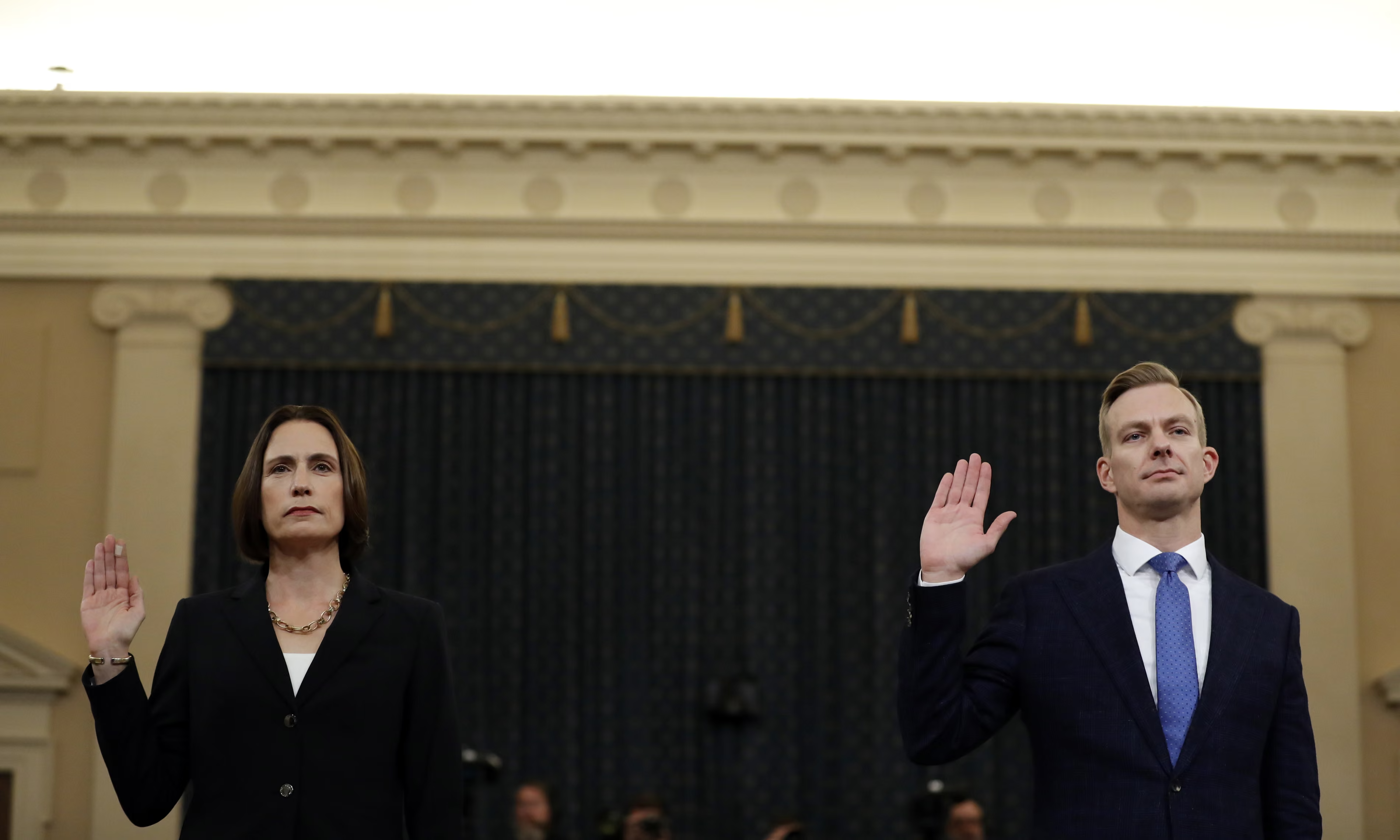
Former White House Russia adviser Dr. Fiona Hill testified before Congress on Nov. 21, 2019, warning that a conspiracy theory blaming Ukraine (not Russia) for 2016 election interference was a “fictional narrative” crafted by Russian security services.
Hill implored U.S. officials not to become unwitting agents of Kremlin propaganda.
Social Media Psy-Ops and Electoral Meddling
The most visible intersection of Russian influence with the American right came via social media in the 2016 election – and it has repeated since.
The U.S. intelligence community and bipartisan Senate investigations have established that Russia’s Internet Research Agency (IRA), a Kremlin-linked “troll farm,” ran a vast online disinformation campaign in 2016 aimed at inflaming U.S. social divisions and boosting Donald Trump’s candidacy.
This operation blanketed every major platform – Facebook, Twitter, YouTube, Instagram – with hand-crafted fake posts masquerading as American opinion.
Importantly, these campaigns did not spray nonsense at random; they were targeted with marketing-like precision.
As an Oxford University analysis for the Senate found, the Russians “sliced Americans into key interest groups” and tailored content accordingly.
Two groups received special focus: African Americans (who were targeted with voter-suppression messages) and conservatives (who were barraged with nationalist, pro-Trump content).
The IRA’s right-wing targeting was explicit.
Russian operatives created fake grassroots pages like “Being Patriotic,” “Stop All Immigrants,” and “Heart of Texas,” amassing hundreds of thousands of followers by mimicking real Americans.
These pages pumped out memes and slogans on guns, God, immigration, and race – the hot-button issues of the American right.
One Senate-commissioned report observed that “messaging to conservative and right-wing voters sought to do three things: repeat patriotic and anti-immigrant slogans; elicit outrage with posts about liberal ‘appeasement’ of others; and encourage them to vote for Trump.”
At the same time, Russian trolls worked to “dampen African American political participation” by spreading cynicism (e.g. “your vote won’t matter” or urging boycotts of the election).
It was a one-two punch: fire up Trump-leaning blocs, and demoralize segments likely to oppose him.
“The [Russian] activities encouraged those most likely to support Trump to get out to vote while actively… discourage[d] voting among those most likely to oppose him,” summarized an Oxford/Graphika study.
The operation’s entire messaging clearly sought to benefit the Republican Party – and specifically Donald Trump.
What makes this especially disturbing is that it did not stop in 2016.
Moscow’s active measures are ongoing and evolving.
In 2020, according to a declassified U.S. Intelligence Community assessment,
“President Putin authorized… influence operations aimed at denigrating President Biden and the Democratic Party, supporting former President Trump, undermining public confidence in the electoral process, and exacerbating sociopolitical divisions in the US.”
The Kremlin again had a preferred outcome (Trump’s re-election) and again worked to achieve it, this time through more covert channels – including Russian spies feeding disinformation to Trump allies.
One notable case: a pro-Russia Ukrainian lawmaker, Andriy Derkach, met with Trump’s inner circle and pushed fabricated dirt on Biden.
The U.S. Treasury later identified Derkach as an “active Russian agent” and sanctioned him for election interference.
Meanwhile, Russia’s state media and troll farms churned out narratives to “denigrate” Biden (painting him as corrupt or senile) and to amplify divisive issues (such as racial unrest and COVID-19 controversies) to whip up American cynicism.
The strategy remained the same: flood the zone with rumors and polarizing content so that truth becomes just one voice in a cacophony.
The results have been perilous. By early 2021, U.S. officials warned that Moscow’s 2020 interference was “a chronic, widespread and identifiable condition” – not a series of isolated hacks, but a continuous assault on our information environment.
FBI Director Christopher Wray testified that false narratives about election fraud (many with origins or amplification in Russia) contributed to the radicalization that led to the January 6, 2021 Capitol attack.
Indeed, the “Stop the Steal” myth – a baseless claim that the 2020 vote was rigged – spread via a tangled web of online groups and influencers, some of which had known Russian troll involvement.
By the time of the Capitol riot, American trust in the electoral process – a bedrock of self-government – had been severely eroded, just as the Kremlin intended.
In a grim full circle, the Russian media gleefully replayed footage of the Capitol chaos as proof of U.S. hypocrisy and decline. The Russian active measure had become an American active rebellion.
Money Trails and Influence Peddling: From the NRA to Think Tanks
Beyond social media, Russian operators have penetrated U.S. conservative circles through old-fashioned financial influence and person-to-person lobbying.
One brazen example revolved around the National Rifle Association.
In 2015, as the presidential campaign geared up, two Russians – Alexander Torshin, a Kremlin-linked banker, and Maria Butina, a young gun-rights activist – cultivated close relationships with the NRA’s leadership.
Documents and a Senate investigation later showed that the NRA effectively acted as a “foreign asset” for Russia in this period.
Top NRA executives visited Moscow in 2015 on trips arranged and funded by Torshin and Butina, meeting with senior Kremlin officials like Foreign Minister Sergei Lavrov.
In turn, the NRA welcomed Russian delegations to its own events, giving Butina and her handlers access to influential Republicans at NRA conventions, prayer breakfasts, and private meetings.
The Senate report alleges that the NRA leadership lied about these contacts and may have violated tax laws by using donor money for insiders’ benefit on the Russia trips.
More alarmingly, the NRA’s political spending surged in 2016 – it poured $30 million into Trump’s election effort (the most of any outside group).
U.S. investigators probed whether some of these funds were funneled from Russia via shell entities (a practice banned by law).
While definitive proof of illegal donations remains elusive publicly, Senate Finance Committee investigators concluded that
“Russia used the NRA as a means of accessing and influencing U.S. conservative politics”.
And indeed, Maria Butina later pleaded guilty to acting as an unregistered foreign agent – essentially admitting she infiltrated Republican circles (from the NRA to the National Prayer Breakfast) under secret Kremlin direction.
Her mission was to “infiltrate U.S. conservative groups” and “promote Russian interests around the 2016 election,” as the Justice Department described it.
The NRA case is illustrative: it shows how Russian influence operations straddle both overt narrative war and covert agent-of-influence tactics.
On one hand, Butina presented herself openly as a gun-rights crusader seeking common cause with American patriots – appealing to shared ideology (gun ownership and religious conservatism) as a basis for friendship.
On the other hand, she was secretly reporting to a Russian official and pursuing Moscow’s agenda:
namely, to build a “back channel” to GOP presidential candidates and encourage a pro-Russia shift in U.S. policy.
The effort bore fruit.
In 2016, candidate Trump openly questioned NATO and signaled a warmer stance toward Putin, positions echoing Moscow’s preferences more than traditional GOP doctrine.
The Republican Party platform even mysteriously softened language on arming Ukraine against Russian aggression – a subtle but striking change that former campaign officials later tied to pressure from Trump’s team.
While we cannot say Russia “caused” these shifts, the convergence of messaging is unmistakable: what Russian operatives were whispering to American conservatives in private was often the same thing Russian trolls were shouting on Facebook – and, soon, what certain American politicians were declaring on the campaign trail.
Further evidence of Russian courtship of the American right comes from a series of U.S. indictments in 2022–2023 that read like spy novels.
In July 2022, the Justice Department charged Aleksandr Ionov, a Moscow-based operative working for Russia’s FSB intelligence service, with orchestrating a “years-long foreign malign influence campaign” on U.S. soil.
Ionov’s scheme, active from 2014 through 2022, involved recruiting and funding political groups in Florida, Georgia, and California to sow discord and spread pro-Russian propaganda.
He bankrolled rallies and protests, pushed Kremlin talking points through these groups, and even coordinated coverage of their activities in Russian state media.
Notably, one target was a fringe secessionist group in Florida, and another was a radical left-wing group – showing that Russia will exploit any wedge, left or right.
But the pattern remains: identify polarized “hot spots” in American society (be it racial justice, states’ rights, or anti-war sentiment), then fund and flatter the extremists on each end to make the flames taller.
FBI wiretaps caught Ionov’s American collaborators acknowledging he worked for the Russian government – which “did not disturb us,” one said bluntly.
Here were self-proclaimed American activists willing to let a hostile foreign power bankroll their cause, so long as it hurt their domestic enemies.
Perhaps the most jaw-dropping recent case emerged in 2024: an FBI investigation exposed that a popular right-wing media outlet called “Tenet Media” was secretly funded with $10 million from Russian sources.
Tenet had hired a stable of MAGA-friendly influencers – including YouTubers and pundits with millions of followers – to produce content that, among other things, downplayed Russia’s invasion of Ukraine and criticized U.S. support for Kyiv.
The influencers (among them Tim Pool, Dave Rubin, and Benny Johnson) insisted they were “duped” and had no idea their paychecks came via a Russian shell company.
But regardless of their claimed ignorance, the effect was the same:
American audiences were fed Kremlin-friendly narratives by personalities they trusted, without disclosure that Moscow was literally footing the bill.
Attorney General Merrick Garland called the indictment “the most sweeping” yet against Russian disinformation efforts, noting the Tennessee-based front company never registered as a foreign agent while pushing videos “in favor of Moscow’s interests”.
It is hard to imagine a more direct intersection of Russian influence and modern U.S. right-wing media: a foreign-funded propaganda mill, laundered through an all-American cast of YouTube stars, beaming into homes across the nation.
Narrative Synergies: Ideology as the Bridge
Beyond money and bots, there is a deeper ideological convergence that has made segments of the American right particularly fertile ground for Russian influence.
In recent years, Putin’s Russia has styled itself as a champion of traditionalism, nationalism, and Christian orthodoxy against a decadent, globalist West.
This messaging – heavy on anti-LGBT rhetoric, appeals to white Christian identity, and disdain for multilateral institutions – resonates with alt-right and far-right narratives in the United States.
The result is an odd kind of horseshoe effect, where right-wing Americans find themselves echoing Kremlin talking points not because they were paid or tricked, but because those talking points feel right in their own cultural context.
Consider the “Ukraine meddling” conspiracy theory mentioned earlier.
In 2019, as impeachment loomed over President Trump’s attempt to extort political favors from Ukraine, some of his allies began pushing a counter-narrative: that actually Ukraine had interfered in the 2016 U.S. election to hurt Trump, and Russia was blameless.
This theory was utterly debunked by U.S. intelligence, but it gained traction in conservative media.
Dr. Fiona Hill – a lifelong Russia expert and Trump’s own former NSC adviser – was so alarmed that she used her congressional testimony to directly “ask that you please not promote politically driven falsehoods that so clearly advance Russian interests”.
She stated flatly that the idea of Ukrainian interference was a “fictional narrative perpetrated by the Russian security services”.
In other words, Kremlin spies cooked up a lie to shift blame for 2016, and here were American politicians repeating it on the floor of Congress.
Hill’s warning was striking: elected officials were acting as unwitting agents of Russian propaganda, all while claiming to defend America.
The absurdity would be comical if it weren’t so dangerous: a hyper-patriotic faction, draped in the flag, but inadvertently carrying water for an ex-KGB dictator’s misinformation campaign.
We see similar absurd convergences around other narratives.
For instance, after Russia launched its brutal war on Ukraine in 2022, most Americans supported aid to Ukraine.
But a loud faction on the far-right adopted an isolationist, even pro-Putin stance:
“Why should we help Ukraine? Ukraine is corrupt; Putin is fighting nazis; focus on our border instead.”
These claims often originated in Russian state media or propaganda memes, yet soon they were being parroted by U.S. talk show hosts and politicians.
The most-watched cable host at the time, Tucker Carlson, spent weeks questioning Ukraine’s legitimacy, sympathizing with Russia’s security concerns, and airing Kremlin-favored angles – to the point that Russian TV broadcasts began regularly featuring Carlson’s monologues with approval.
When Congresswoman Marjorie Taylor Greene vowed “not another penny to Ukraine” and suggested Ukraine was laundering U.S. aid, her statements earned praise on Russian Telegram channels that see such U.S. voices as crucial amplifiers.
In effect, parts of the American right have voluntarily synchronized with Russian disinformation, because it aligns with their “America First” or anti-globalist worldview.
The feedback loop is tight: Russia pushes a narrative (e.g. “Ukrainian biolabs” or “European elites want to replace you”), U.S. conspiracists pick it up, and then Russia cites those U.S. voices as validation, and so on, until distinguishing who originated the idea becomes impossible.
It’s a hall of mirrors – or to quote Baudrillard, a simulation where “the real becomes indistinguishable from its representation; what is true becomes indistinguishable from what is false or fake”.
Thinkers like Jean Baudrillard anticipated this collapse of meaning in a “hyperreal” media age.
Baudrillard wrote that an excess of information – constant images, claims, denials, and counterclaims – does not enlighten people, it “produces uncertainty… an irreparable uncertainty”, leaving the public both over-saturated and cynical.
In such a state, he observed, “information does not inform”; people have all the data in the world at their fingertips, yet no solid truth to stand on.
The Kremlin couldn’t ask for a better environment to ply its trade.
Russia doesn’t need to make you believe their version of events; it merely needs to ensure you stop believing any version.
When nothing is credible, the field is open for the boldest liar to seize the day.
Indeed, in 2016, that dynamic favored a candidate willing to dismiss every authoritative voice (intelligence agencies, mainstream media, scientists) as biased or fake, while peddling wild counter-narratives that overwhelmed the zone.
This “implosion of the social in the media,” to use Baudrillard’s phrase, is precisely what Russia’s active measures exploit.
They turned social media – once hailed as tools of liberation – into a fog machine of unreality where millions of Americans now consume a steady diet of conspiratorial, rage-inducing content that keeps them angry but also inert in any constructive sense.
Here we can invoke Herbert Marcuse and his concept of repressive desublimation.
Marcuse argued that advanced societies maintain control not just by overt repression, but by allowing people to indulge their base impulses in a controlled way, thereby defusing real resistance.
In our context, think of how the outrage and desire for rebellion among segments of the right are channeled: rather than organizing effectively to solve societal problems, they are encouraged to
vent in echo chambers,
chase lurid fantasies (QAnon’s cabals, “deep state” witch-hunts),
buy merchandise,
attend rallies that feel revolutionary but accomplish little beyond spectacle.
It’s a kind of political pornography – emotional gratification that goes nowhere.
Marcuse noted that society can “extend liberty while intensifying domination,” granting certain freedoms or pleasures that ultimately “promote social cohesion and contentment” in a way that preserves the status quo.
The modern far-right ecosystem, amplified by both domestic opportunists and foreign agents, provides endless content to stoke anger (against immigrants, minorities, “traitorous” officials, etc.), which in turn keeps viewers hooked (making media companies money) and perpetually aggrieved.
But it rarely translates into effective political change – instead it often undermines the very institutions that could address grievances.
This is repressive desublimation:
the release of aggression or desire in forms that actually reinforce one’s powerlessness.
Followers feel they’re part of a grand crusade (storming a pizza parlor in search of imaginary traffickers, or “owning the libs” on Twitter) but in reality they are, as Marcuse would say,
“satisfied in a way which generates submission and weakens the rationality of protest.”
The Russians could hardly design a better system: America’s own media and capitalism have created a propaganda market where the most outrageous lies win the most clicks, and where cynicism and nihilism flourish – a situation that neutralizes thoughtful civic action, leaving a vacuum easily filled by extremist demagogues (foreign or domestic).
Finally, consider Carl Jung’s insight about the shadow.
Jung observed that groups often project their denied flaws onto others as a psychological defense.
In the context of Russian influence, this is almost too perfectly illustrated.
Segments of the U.S. right have obsessively accused their opponents of being underhanded globalists, puppets of shadowy forces, or traitors to the nation.
Yet here we have evidence that it is precisely some of these accusers who have been under the sway of a foreign autocrat’s “shadow” campaign.
The projection is stark: those crying “fake news” became conduits for fake news; those denouncing “deep state” plots embraced a real plot hatched in Moscow’s halls.
It brings to mind the old McCarthy-era trope of finding Reds under every bed – except now the proverbial Red is actually in the bed, whispering in the ear of the paranoiac who’s too busy hallucinating enemies to notice.
Jung might say that America’s radical right, unable to face its own capacity for subversion and deception, has projected that evil outward – all while the true source of corrosive influence (the collective Russian shadow, so to speak) manipulates them from within their ranks.
It is a diabolical mirroring: the more the far-right projects its shadow (accusing others of the very malfeasance it partakes in), the more it opens itself to exploitation by an external malevolence that feeds on such blindness.
Analysis: Systemic Vulnerabilities and the Shadow of 2025
When we step back, a disquieting picture emerges.
The recurring intersections of Russian influence and U.S. right-wing movements are symptoms of systemic weaknesses – fissures in our political culture, information ecosystem, and even psyche that foreign adversaries have expertly exploited.
These vulnerabilities span the political spectrum to a degree (Russia has also cultivated the far-left when useful), but the synergy with the contemporary far-right is especially pronounced.
One systemic issue is the unregulated Wild West of digital media.
Social media companies, driven by engagement metrics, created algorithms that reward extremism and sensationalism.
This made it trivially easy for foreign agents to masquerade as loud Americans and outperform authentic civic voices.
A Senate review warned that in 2016, Russian trolls weaponized our “American-bred” platforms to an extent tech CEOs refused to admit – and that this is now a chronic condition needing aggressive management.
Yet efforts to impose “guardrails” (such as monitoring bots or flagging fake news) have been met with partisan backlash.
Project 2025 explicitly proposes to punish social media companies for moderating content, threatening them with legal reprisals if they limit the spread of “core political viewpoints” – code words that include election conspiracies and extremist narratives.
In essence, the plan would hamstring attempts to rein in disinformation, giving foreign propaganda freer rein.
This is a stark feedback loop: because falsehoods took hold among a faction of Americans, that faction now seeks to prohibit the very countermeasures (e.g. fact-checking, content removal) that might block the next Russian disinformation onslaught.
It is as if the patient, convinced the doctor is part of a plot, is tearing out the IV line – even as the infection spreads.
Another vulnerability is the dark money quagmire of U.S. politics.
Our campaign finance system (post-Citizens United) makes it relatively easy for foreign funds to be laundered into Super PACs or nonprofits under the guise of domestic donations.
The NRA case showed how Russian money can flow through an interest group into the political bloodstream with little transparency.
Likewise, many organizations that collaborated on Project 2025 receive millions in opaque donations – nearly half have ties to Leonard Leo’s funding network, raising concerns about undisclosed influencers.
In a world where even American oligarchs can bankroll agitprop, the added infusion of Russian oligarch cash is hard to trace.
Thus, the financial firewall is weak.
The Kremlin’s wealthy cronies have courted U.S. think-tanks, universities, and lobbyists for years (a Russian bank donated to a Trump-aligned think tank; an RT-affiliated group courted U.S. veterans with free trips; and so on).
When money can buy megaphones and political clout without clarity of origin, active measures become exponentially easier.
We must also confront partisan polarization as a national Achilles’ heel.
America’s political divide has become so toxic that many individuals will support anything that hurts the “other side,” even if it means inviting foreign manipulation.
This was explicitly noted in the Ionov indictment: the Russians targeted both far-left and far-right fringe groups, knowing each would gladly take help if it advanced their fight against their domestic opponents.
A Black socialist group in Florida was allegedly willing to coordinate with Ionov because he flattered their anti-capitalist aims;
a Texan secessionist group embraced Russian outreach because it validated their anti-federal grievances.
In both cases, ideological zeal outweighed patriotism.
Similarly, when Republican officials in 2019 latched onto the Kremlin-planted Ukraine conspiracy, they did so because it seemed to shield their champion (Trump) and hurt their rivals (Democrats).
Facts be damned.
This willingness to believe the absurd if it hurts your enemy is precisely what active measures rely on.
Moscow doesn’t have to persuade the majority, just energize a passionate minority to inject chaos into the system.
Democracy’s guardrail – a shared commitment to truth and the national interest – gets overridden by zero-sum factionalism.
As George Washington presciently warned, “domestic factions” open the door to foreign influence.
We are living that warning:
factions so estranged that they’ll amplify a foreign lie if it slanders their fellow Americans.
The intellectual crisis of our time is also central.
A functioning democracy depends on educated skepticism – the ability to sort evidence and discern truth.
But we have entered an era of weaponized relativism,
where “alternative facts” and conspiratorial thinking have eroded the Enlightenment norms of reason.
This is part of the epistemic collapse discussed earlier.
When millions truly believe that a cabal of satanic pedophiles runs the government (as QAnon alleges), or that the 2020 election was stolen by a vast international plot, it becomes nearly impossible to correct or even converse.
Russian disinformation did not invent American anti-intellectualism or gullibility, but it ruthlessly amplifies it.
And when a portion of the populace is essentially living in what Baudrillard would call a hyperreal simulation –
a fully enclosed narrative that need not correspond to empirical reality –
traditional defenses against propaganda fail.
In past decades, a blatantly false story (say, Pizzagate) could be debunked by mainstream media and authorities, and the majority would accept the debunking.
Today, debunking often only entrenches false belief: the fact-check is seen as part of the cover-up, the absence of evidence as evidence itself (a Kafkaesque trap).
This epistemic free-fall was the Kremlin’s ultimate objective.
The aforementioned ODNI report noted Russia’s goal went “beyond the U.S. presidential campaign” to “weaken Washington” in the long run by fostering internal division and mistrust.
They correctly judged that a United States that cannot agree on basic reality is a United States hamstrung on the world stage.
We can see this in how COVID-19 was handled (with disinformation hindering public health) or how support for Ukraine wavers (with propaganda eroding consensus). A “house divided” is Putin’s strategic jackpot.
Where does Project 2025 fit into this? In many ways, Project 2025 can be seen as a reactionary response to the chaotic years of Trump and the perceived leftward shift under Biden.
Its authors want to seize the machinery of government and implement hard-right policies swiftly and irreversibly.
But in doing so, they exhibit a startling indifference to (or ignorance of) how their plans could play straight into foreign adversaries’ hands.
For instance, the project’s hostility to the U.S. civil service and intelligence community – painting them as a “deep state” to be purged – directly aids Russia by hollowing out America’s national security and counterintelligence capacities.
A government whose experts are muzzled or removed is less able to counter covert foreign interference.
Moreover, Project 2025’s apparent intent to validate Trump’s “Big Lie” about 2020 by targeting those who debunked election fraud myths is deeply self-destructive.
If these policies went through, the federal government would essentially be forced to parrot disinformation or stay silent, leaving Americans even more vulnerable to the next big lie – domestic or foreign.
In short, the project’s vision of governance – maximal executive power, minimal accountability, ideological loyalty tests for officials – mirrors the kind of system Putin himself operates.
It is grimly ironic:
to “save” America, these activists propose to remake it in a more authoritarian mold, one that might actually please the Kremlin.
Little wonder a commentator quipped that “the real Project 2025 was written in Moscow”, noting how Putin would relish a second Trump term that cuts off aid to Ukraine and perhaps even triggers domestic turmoil in the U.S.[70].
Indeed, leaked Russian strategy documents (from 2023) reportedly outlined a “Good Old USA” project aimed at using “blatant racism, xenophobia, and homophobia” to rally American voters toward a candidate like Trump.
That reads like a play-by-play of our culture wars – a strategy of repressive desublimation by exacerbating social hatred and fear to keep citizens from uniting on anything constructive.
To be clear, none of this absolves Americans of agency.
The uncomfortable truth is that Russia’s active measures succeed only insofar as we allow them to.
The Kremlin did not create American racism, or anti-science sentiment, or hyper-partisan rage; those are homegrown maladies.
But Moscow has shown a fiendish talent for weaponizing our own worst instincts against us.
It is as if the Russian operators have acted as a malicious therapist, drawing out our societal “shadow” (to use Jung’s term) – our paranoia, tribalism, and nihilism – and magnifying it on the national stage.
They reflect back to each faction a distorted funhouse mirror image of its fears and resentments, encouraging each to see the other as monsters.
The genius (or devilry) of this approach is that after a while, Americans do the work for them: we distrust each other more than we distrust any foreign foe; we consume and spread lies without any Russian intermediary because the narratives have taken on a life of their own; we even threaten violence against fellow citizens over phantom conspiracies.
This is why tackling this problem is not as simple as “blocking Russia” – the enemy is now inside the gates, in our feeds and minds.
Conclusion
The intersection of Russian influence operations and the modern American right is not a series of isolated incidents but a pattern revealing a profound strategic vulnerability.
It lays bare a dark irony: those most loudly proclaiming themselves patriots, saviors of the republic from within, have been among the most susceptible to manipulation by a foreign adversary.
The systemic truth is that our democracy has been caught in a dangerous feedback loop – a “simulation” of patriotism that in fact hollows out the real substance of it.
Russian active measures have amplified extremism and distrust; that extremism then pushes policies (like gutting disinfo countermeasures or embracing isolationism) that further “erode public confidence in the machinery of government” and leave us exposed to more influence.
It is a loop that, if not broken, could become a death spiral for pluralistic democracy.
Breaking it will require a recommitment to clarity, truth, and civic unity that currently feels in short supply.
It will require conservatives of principle to reject the siren song of Russian-enabled propaganda even when it seems to offer short-term advantage.
It will require liberals to address the grievances that make people turn to demagogues and conspiracies, thereby undercutting the market for such poison.
And it will require systemic reforms: transparency in financing, sensible tech regulation, robust civics education, and – above all – accountability for those who deliberately peddle foreign-origin lies to the public.
In the final analysis, the story of Russian influence in the age of Project 2025 is a cautionary tale of a great power being undone from within by the weaponization of its freedoms and fractures.
It highlights what Herbert Marcuse observed about free societies: that freedom can be turned against itself, letting “liberty” become the liberty to deceive and be deceived, until true liberty – which rests upon informed, rational consent – is lost.
It also echoes Jung’s warning that refusing to acknowledge our own darkness projects it outward, making us vulnerable to enemies who will happily play the part we’ve imagined.
In confronting this, perhaps we must rediscover a bit of collective humility and common purpose.
One might recall that during the Cold War, even amid fierce domestic disputes, there was a baseline agreement that Soviet propaganda was not to be trusted.
Today, that consensus is gone – one party’s misinformation is another party’s gospel.
If that state of affairs persists, America risks becoming, as Arendt foresaw, a people that “can no longer believe anything,” ready to accept “the most absurd claims” of demagogues.
Such a people, she noted, will eventually lose both the capacity to judge and the capacity to act, paving the way for tyranny.
The shadow of that outcome looms in the Project 2025 agenda, with its whiff of authoritarian concentration of power, its purge mentality, and its open scorn for the safeguards that prevent despotism.
But knowledge is under fire, not defeated.
By shining a light on these dark intersections – by naming the active measures, dissecting the narrative warfare, exposing the absurdities – we arm ourselves with understanding.
The truth can still cut through the noise, if wielded sharply and unapologetically.
And the truth is that Russia’s influence campaign succeeded not by making us invincible zombies, but by encouraging us to be our worst selves.
The antidote, then, is to be our better selves: more critical in thought, more united in purpose, more faithful to the democratic ideals that adversaries seek to tarnish.
We close with a sober mind and a pointed reminder:
America’s enemies, open and hidden, can only win if we let them. Recognizing how we have let them – and vowing to stop – is the first step out of this long, dark night.
Sources:
- Senate Select Committee on Intelligence, Russia’s Use of Social Media, Press Release (Oct. 8, 2019)[1][37]
- DemTech Project, Oxford University & Graphika, Analysis of IRA Social Media Operations (2018)[2][26]
- Senate Intelligence Committee, report on IRA influence (2018), via BBC coverage[2]; PBS NewsHour summary[28][26]
- U.S. Office of the Director of National Intelligence, ICA: Foreign Threats to 2020 Elections (Mar. 2021)[31][33]
- The Guardian, “NRA acted as ‘foreign asset’ to Russia” (Sep. 2019)[40][41]
- U.S. Department of Justice, Indictment of Aleksandr Ionov (July 2022)[44][45]
- The Guardian, “US conservative influencers ‘victims’ of Russian campaign” (Sep. 2024)[49][51]
- The Philadelphia Inquirer, “Putin’s strategy for Project 2025” (Sept. 2024)[70][71]
- Fiona Hill testimony, House Intelligence Committee (Nov. 21, 2019), via The Guardian[21]
- Brennan Center for Justice, “Project 2025 aims to derail efforts to stop disinformation” (Aug. 2024)[20][19]
- Wikipedia, Project 2025 (accessed 2025)[3] (Background on Heritage plan)
- Hannah Arendt interview (1973), quoted in Kim et al., AI & Collapse of Trust (2023)[15][16]
- Jean Baudrillard, Simulacra and Simulation (1981), discussion in Critical Legal Thinking (2018)[53][54]
- Herbert Marcuse, One-Dimensional Man (1964), discussion in Revolution & Ideology (Medium, 2019)[60][62]
[1] [37] Senate Intel Committee Releases Bipartisan Report on Russia’s Use of Social Media | Senate Select Committee on Intelligence
[2] [22] [23] [24] [25] [26] [27] [28] [29] [30] [35] [36] DemTech | Coverage: Russia’s IRA and American Political Polarization
[3] [17] Project 2025 – Wikipedia
https://en.wikipedia.org/wiki/Project_2025
[4] [8] [9] Active Measures: Russia’s Covert Geopolitical Operations | George C. Marshall European Center For Security Studies
[5] intelligence.senate.gov
[6] [7] Russians Targeted U.S. Racial Divisions Long Before 2016 And Black Lives Matter : NPR
[10] [11] [15] [16] [75] **AI Chernobyl and the Collapse of Civilization: Diagnosing and Rebuilding the Architecture of Trust
https://philarchive.org/archive/KIMMAC-2
[12] [13] [14] Epistemic Collapse: The Gray Rhino That Threatens All Other Responses | by Darwin Gosal | Medium
[18] [19] [20] [64] [65] [68] [69] Project 2025 Aims to Derail Efforts to Stop Election Disinformation | Brennan Center for Justice
[21] [66] Fiona Hill: stop ‘fictional narrative’ of Ukraine meddling in US election | Trump impeachment inquiry (2019) | The Guardian
[31] [32] [33] [34] [67] dni.gov
[38] [39] [40] [41] [42] [43] NRA acted as ‘foreign asset’ to Russia before 2016 election, says Senate report | NRA | The Guardian
https://www.theguardian.com/us-news/2019/sep/27/nra-russia-foreign-asset-senate-report-investigation
[44] [45] [46] [47] Office of Public Affairs | Russian National Charged with Conspiring to Have U.S. Citizens Act as Illegal Agents of the Russian Government | United States Department of Justice
[48] [70] [71] [72] Trump’s real Project 2025 was written for him in Moscow by Vladimir Putin’s men | Opinion
https://www.inquirer.com/opinion/commentary/gop-trump-campaign-russia-propaganda-20240908.html
[49] [50] [51] US conservative influencers say they are ‘victims’ of Russian disinformation campaign | US elections 2024 | The Guardian
[52] Witness denounces ‘fictional’ Ukraine election interference | PBS News
https://www.pbs.org/newshour/politics/witness-denounces-fictional-ukraine-election-interference
[53] [54] [55] [56] [57] Did Baudrillard foretell the advent of fake news? From disinformation to hyperinformation
[58] [59] [60] [61] [62] [63] [73] [74] On Herbert Marcuse’s “One-Dimensional Man” | by Nick Lee | Revolution and Ideology | Medium
-Brett Urben
 Gnosis Under Fire
You must be logged in to post a comment.