Executive Summary
This intelligence assessment provides a comprehensive, preventive, and scenario-based open-source intelligence (OSINT) analysis of the potential for third-party actors to exploit Dave Chappelle’s high-profile public persona, financial activities, cultural influence, and local footprint in Yellow Springs, Ohio, to advance Racially or Ethnically Motivated Violent Extremism (RMVE) objectives. The analysis operates under the assumption that Mr. Chappelle acts in good faith as a comedian, entrepreneur, and cultural commentator without malicious intent or direct organizational ties to any extremist group. The core objective is to identify structural vulnerabilities within his platform that could be leveraged for narrative amplification, soft radicalization, local influence consolidation, or the establishment of precedents for foreign funding, thereby contributing to the development of more robust influencer monitoring doctrine within domestic counterterrorism.
The central scenario posits an external actor—domestic or foreign—leveraging Chappelle’s unique combination of massive digital reach, perceived authenticity as a cultural commentator, significant financial assets, and deepening roots in a small American town. This exploitation would occur without his knowledge or consent, using his platform to normalize and amplify fringe ideologies congruent with certain strains of Black Nationalism, which fall under the current FBI/DHS definition of RMVE. The primary mechanism of exploitation would not be through direct recruitment but through “narrative laundering,” where his comedic framing serves to legitimize and sanitize separatist, anti-government, or economically nationalist themes for a mass audience before they are repurposed by extremist actors. The analysis specifically examines how the post-2019 institutional shift away from the retired “Black Identity Extremism” (BIE) designation to the consolidated RMVE category may create doctrinal blind spots, potentially hindering the early detection of these subtle, non-violent influence operations that do not fit traditional violent extremism profiles.
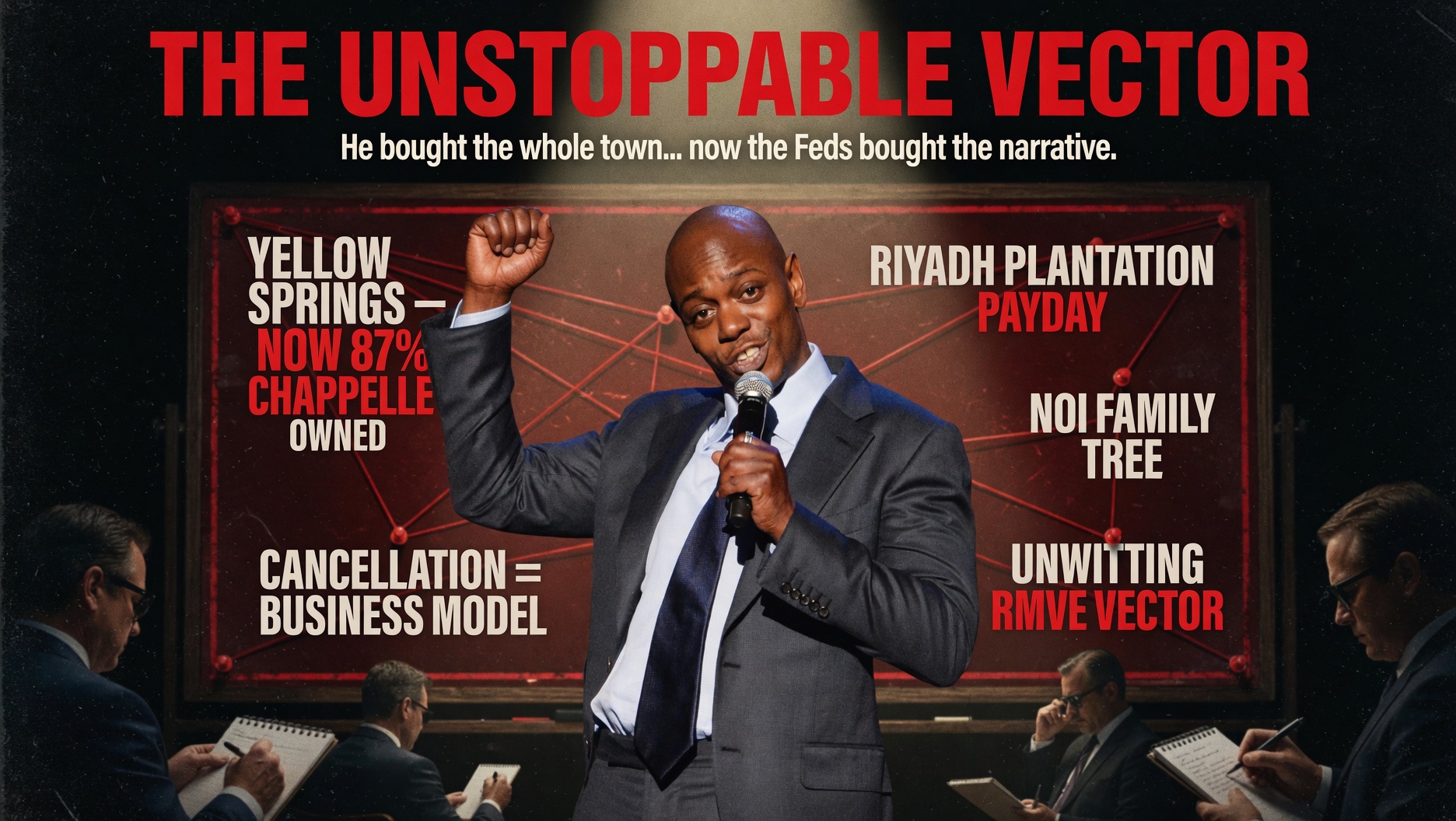
Key public triggers and developments analyzed for this assessment span the 2024–2026 period. These include the release of his December 2025 Netflix special, The Unstoppable, which reportedly features explicit jokes about purchasing and “owning most” of Yellow Springs, thereby literalizing themes of economic sovereignty; his continued defense of performing at the Saudi/Riyadh Comedy Festival, framed as a triumph of free speech and economic empowerment; his documented expansion of real estate holdings through the entity Iron Table Holdings LLC, including the acquisition of a former schoolhouse for WYSO public radio; his established “cancellation-as-business-model” cycle, which has generated hundreds of millions in revenue and reinforces a narrative of resilience against oppressive systems; and his private Islamic faith and family’s historical exposure to Nation of Islam (NOI) ideology.
Based on this analysis, several key risk indicators have been identified and assessed with corresponding probability and confidence ratings. High-confidence indicators include the immense and uncontrollable digital amplification of his content, which frequently travels into ideologically charged online communities, and the strong thematic resonance between his long-standing comedic critiques (of feminism, political correctness, and social justice movements) and foundational grievances articulated by some RMVE factions. Medium-confidence indicators include the tangible consolidation of his influence through real estate ownership in Yellow Springs, which creates physical nodes for potential organizing, and the precedent he has set regarding international performance and state-linked funding. Low-confidence indicators include any evidence of direct financial or operational ties to designated RMVE organizations, which remains absent in the provided open-source data.
The worst-case outcome modeled is one in which an adversary successfully positions Dave Chappelle as a symbolic figurehead for a domestic RMVE movement. His statements and actions are selectively amplified online to legitimize separatist, anti-government, or economically nationalist ideologies. His Yellow Springs properties become a focal point for gathering sympathizers, and his international work sets a precedent for accepting foreign funds under the guise of artistic freedom. This multi-faceted threat vector is particularly difficult to counter due to his protected status as a First Amendment speaker, making overt intervention legally and politically fraught.
The overall preventive recommendation level for this subject is Monitor and Analyze.
The primary value of this assessment lies not in targeting an individual but in using the Dave Chappelle case study to develop a more sophisticated framework for identifying similar vulnerabilities across the landscape of high-profile cultural influencers. Its national-security utility is to inform counterterrorism doctrine by highlighting the need for analysts to look beyond direct affiliations and focus on ecosystem dynamics, amplification patterns, and the dual-use nature of content. By understanding how seemingly benign cultural commentary can be co-opted, agencies can better anticipate and mitigate the subtle threats posed by the fusion of popular culture and extremist narratives.
Subject Profile & Public Persona (2026 Update)
A detailed examination of Dave Chappelle’s public profile through 2026 reveals a complex figure whose evolution from a nationally recognized stand-up comedian to a prominent landowner and cultural commentator in Yellow Springs, Ohio, has created a unique and multifaceted platform. This platform, while operating in good faith, contains several structural characteristics that make it a potential target for unwitting exploitation by third-party actors seeking to advance Racially or Ethnically Motivated Violent Extremism (RMVE) objectives. The analysis of his persona must consider his biographical trajectory, the thematic content of his recent work, the mechanics of his commercial success, and the sheer scale of his digital reach and amplification.
Chappelle’s transition into a permanent resident and influential stakeholder in Yellow Springs represents a significant shift in his public role. Once a transient celebrity known primarily for his comedy tours and specials, he has now become deeply embedded in the civic and economic fabric of a small Midwestern town. This transformation is facilitated through his business entity, Iron Table Holdings LLC, which has been actively acquiring property in the downtown area. While the precise scale of this portfolio requires verification through recent Ohio Secretary of State business filings and Greene County GIS parcel data, reports indicate the purchase and planned restoration of a former schoolhouse for WYSO public radio. This act of community reinvestment serves multiple functions: it generates goodwill, projects an image of wealth and stability, and establishes a physical presence that goes far beyond that of a typical absentee landlord. As a major landowner, Chappelle gains substantial leverage over local politics, zoning decisions, and community life, creating tangible assets that could be exploited as nodes for local influence consolidation or even physical organizing. His stated goal of “owning most” of Yellow Springs, as reported in connection with his 2025 Netflix special, moves this consolidation from a private ambition into a public declaration of economic and political control, directly mapping onto RMVE tenets of community sovereignty and self-determination.
The centerpiece of his recent public-facing work is the December 2025 Netflix special, The Unstoppable. The content of this special is a critical element of the risk assessment, as it articulates his worldview and presents clear points of vulnerability. Reported material includes explicit jokes about his real estate acquisitions and a boastful claim to “owning most” of Yellow Springs. This rhetoric, while delivered in a comedic context, constitutes a literal assertion of dominance over a community’s economic and civic infrastructure. It also contains other politically charged content, such as criticism of Israel and a pointed critique of fellow commentator Bill Maher, indicating his continued engagement with contentious social and political issues. This positioning allows him to frame himself as a fearless truth-teller unafraid to challenge powerful institutions, a persona that is highly attractive to audiences predisposed to grievance-based ideologies.
The exact quotes from the special would be necessary for a definitive doctrinal alignment with RMVE/BIE indicators, but the reported themes are sufficiently suggestive to warrant concern. The special’s release on a global platform like Netflix ensures that these messages reach a vast and diverse audience, many of whom may interpret them through their own ideological lenses, independent of Chappelle’s original intent.
A crucial component of Chappelle’s contemporary persona is his successful navigation of what has been termed a “cancellation-as-business-model.” He has repeatedly courted intense public controversy, particularly around his treatment of transgender individuals and feminism, only to see his subsequent Netflix specials achieve unprecedented viewership and generate hundreds of millions of dollars in revenue. This pattern has created a resilient business model where backlash fuels demand, reinforcing a narrative of triumph over censorship and oppression. In this dynamic, Chappelle is not merely a victim of “cancel culture” but an active participant who weaponizes controversy for financial gain. This narrative of resilience is potent and easily co-opted by RMVE actors who also frame their struggles as a fight against an oppressive establishment. By portraying himself as a martyr for free expression, he provides a powerful template for others who wish to justify controversial or inflammatory speech as a legitimate form of resistance. This cycle strengthens his position as a trusted voice for those who feel marginalized by mainstream discourse, further expanding his potential audience base for unwitting exploitation.
Finally, the sheer scale of his reach and the nature of its digital amplification represent a fundamental vulnerability. Dave Chappelle commands a massive audience, and clips from his routines are widely shared across social media platforms, especially X (formerly Twitter) and TikTok. This amplification is largely organic and uncontrolled, meaning he exercises little to no oversight over how his words are used once they leave his curated specials. Online ecosystems, particularly those focused on race, gender, and culture, actively seek out and disseminate his material, creating an environment ripe for narrative manipulation. Controversial or provocative lines from his comedy are often stripped of their original comedic context and repurposed as standalone “facts” or “truths” within RMVE-adjacent communities. This process of decontextualization and re-contextualization is a primary mechanism through which his content can be exploited.
His digital footprint transforms his comedy from a closed-loop entertainment product into an open-source information asset that can be mined and weaponized by third parties. The virality of his content ensures that even a single line can be disseminated millions of times, making it nearly impossible to retract or correct misinformation that may be spun from it.
Known Associations & Ideological Overlaps (RMVE Lens)
An analysis of Dave Chappelle’s known associations and the ideological themes present in his work reveals areas of significant overlap with certain indicators of Racially or Ethnically Motivated Violent Extremism (RMVE), particularly those historically associated with Black Identity Extremism (BIE). While there is no evidence of direct affiliation with any extremist organization, his personal history and thematic content provide fertile ground for external actors seeking to leverage him for narrative purposes. This section maps these overlaps, clearly delineates distinctions, and presents mitigating factors to provide a balanced assessment grounded in open-source data.
The most direct association is rooted in his family’s religious history. Verifiably, a number of his relatives, including his brother William Abdullah Chappelle, converted to Islam. Crucially, William Abdullah Chappelle is affiliated with the Nation of Islam (NOI), a group with a well-documented history of promoting separatist, nationalist, and anti-government ideologies. Ella Little-Collins, a prominent member of the NOI, is another example of the type of affiliation present in his extended family circle. Dave Chappelle himself has described his personal practice as private and has referred to himself as a “bad Muslim.” This history provides a legitimate, if distant, connection to a group whose core tenets align with some RMVE objectives. However, it is critical to note the distinctions. The NOI, founded by Wallace Fard Muhammad, promotes a theology centered on black identity, separation from white society, and economic self-sufficiency. Chappelle’s own public statements suggest a shift towards a more orthodox Sunni practice, though his current level of engagement remains private. This distinction is vital; his current faith practice appears to be a private matter rather than a platform for public activism, which mitigates the immediate risk of him being used as a mouthpiece for NOI-specific dogma. Nonetheless, his past exposure and family ties remain a verifiable fact that can be exploited by actors attempting to categorize him within a specific ideological framework or use his history against him.
Beyond his religious background, the thematic content of his comedy demonstrates significant resonance with RMVE/BIE indicators. A systematic mapping of these themes reveals areas of friction that could be manipulated.
| Theme | Alignment with Chappelle’s Work | Alignment with RMVE/BIE Indicators | Mitigating Factors |
|---|---|---|---|
| Economic Self-Determination | Jokes about owning a majority of Yellow Springs, framing his Riyadh gig as “a Black man making money off the plantation.” | Strong emphasis on economic separation, black-owned businesses, and rejecting white capitalist structures. | He is a successful capitalist within the existing system, not necessarily advocating for its overthrow. His wealth is accumulated through mainstream corporate channels (e.g., Netflix). |
| Institutional Distrust | Criticisms of “cancel culture” and political correctness; general skepticism of authority figures like Bill Maher. | Core tenet of many RMVE groups, including anti-government militias and some Black Nationalist factions that distrust law enforcement and government. | His distrust appears aimed at progressive or “woke” institutions, not necessarily all government or law enforcement bodies. |
| Gender/Cultural Critiques | Longstanding critiques of feminism (“team TERF”), the #MeToo movement, and aspects of modern gender discourse. | Some RMVE factions (e.g., certain male supremacist sub-groups) share these views, creating a potential overlap. | His humor is rooted in satire, challenging norms, and using stereotypes for comedic effect, not promoting a coherent misogynistic or reactionary ideology. |
| Grievance Framing | Articulation of frustrations related to modern social dynamics, perceived hypocrisy, and cultural shifts. | Central to RMVE recruitment, which often relies on validating grievances against a perceived hostile “out-group.” | His grievances are typically framed through a comedic, satirical lens rather than a political or revolutionary one. |
This table illustrates that while Chappelle’s work is not synonymous with RMVE propaganda, it shares significant DNA in terms of grievances, rhetorical style, and targets of critique. For instance, his joke about making money in Saudi Arabia is a masterclass in reframing a controversial act (performing for a government with poor human rights records) into a triumphant narrative of anti-colonial defiance and economic empowerment. This narrative is simple, powerful, and easily digestible, making it highly susceptible to being adopted and amplified by actors looking to promote a similar message. Similarly, his critiques of feminism, while originating as comedic material, tap into pre-existing tensions within the Black community and resonate with segments that feel alienated by mainstream feminist discourse. This thematic overlap does not imply endorsement of RMVE ideology by Chappelle, but it does create a receptive audience base and a body of work that can be “laundered”—that is, repackaged and presented as insightful commentary on systemic oppression by those with extremist agendas.
The concept of “soft radicalization” is particularly relevant here. Chappelle does not preach ideology; he performs a worldview. Through his routines, he validates the grievances of his audience, normalizes a skeptical attitude toward mainstream institutions, and fosters a sense of collective identity. An individual predisposed to RMVE might watch his special and feel their pre-existing beliefs are being articulated with skill and charisma. This process of validation and articulation is a critical precursor to deeper ideological immersion. The risk is not that he will directly convert someone to violence, but that he will prime them to be more receptive to the ideas and narratives promoted by actual extremists. His platform effectively lowers the barrier to entry for those considering a journey down an RMVE path by making the initial, less extreme stages of that journey seem entertaining and intellectually respectable.
Financial & Influence Vectors
Dave Chappelle’s considerable financial resources and the strategic use of his influence create multiple vectors that could be exploited by third-party actors. These vectors include his growing real estate empire, his lucrative relationship with global media platforms like Netflix, and the precedent he has set regarding international funding. Each of these elements contributes to his symbolic capital—the intangible assets of credibility, influence, and perceived authenticity—that can be co-opted for RMVE-related objectives.
The analysis of these financial and influence streams is crucial for understanding the practical means by which his platform could be leveraged.
His most tangible vector is the property empire being built through Iron Table Holdings LLC in Yellow Springs, Ohio. This venture transforms his role from a passive observer to an active architect of a community’s economic and social landscape. By acquiring downtown properties, including a venue for WYSO public radio, he is embedding himself deeply into the civic infrastructure. This activity serves several functions that are attractive to potential exploiters. First, it confers significant local influence. As a major landowner and employer, Chappelle wields disproportionate leverage over local politics, zoning decisions, and community events. This makes him a powerful ally or a formidable opponent for any local initiative. Second, the properties themselves become physical nodes of influence. They can be used for gatherings, meetings, or as a base of operations for individuals or groups wishing to operate under his name or influence. Operating from a space owned by a high-profile, protected cultural figure provides a degree of insulation from official scrutiny, creating a protective veil for activities that might otherwise be considered suspicious. Third, the very act of building this empire serves as a powerful symbol of economic independence and success, a narrative that aligns with RMVE/BIE goals of black economic nationalism and self-sufficiency. The consolidation of his footprint in Yellow Springs is not merely a private investment; it is a public statement of power and permanence that can be interpreted and amplified in various ways.
Another critical vector is his financial relationship with Netflix and other media partners. The economics of his deal are opaque but undoubtedly lucrative, generating hundreds of millions in revenue from his “cancellation-as-business-model” specials. This relationship provides him with a global megaphone, ensuring his content reaches a massive and diverse audience. While Netflix is a purely commercial entity, its association lends a veneer of legitimacy to his work. Any content released through such a channel benefits from its vast distribution network, exponentially increasing its reach and potential for misuse. More subtly, the financial flow itself represents a vector. While there is no public evidence of direct funding flowing from Netflix to RMVE groups, the immense wealth Chappelle accumulates from this relationship increases his capacity to fund projects of his own choosing. If an RMVE actor were to propose a project—a documentary, a film festival, a community center—Chappelle’s financial clout, bolstered by his Netflix earnings, could make him a valuable patron. The risk lies in the ambiguity of his philanthropic intentions; a donation to a seemingly benign community project could, in reality, be a Trojan horse for an RMVE-aligned organization.
Perhaps the most significant precedent he has set is related to international funding. His performance at the Riyadh Comedy Festival and his subsequent public defense of it are highly consequential. By framing the gig as a victory for free speech and an act of economic defiance—”a Black man making money off the plantation”—he has already created a narrative that justifies accepting financial support from non-Western, state-sponsored entities. This framing reframes a controversial decision as a principled stand, setting a powerful and dangerous precedent. If a foreign actor were to fund a future project, they could point to Chappelle’s actions as proof that such collaborations are acceptable and even commendable. This would effectively normalize foreign funding as a tool for narrative building and influence operations. From a counterterrorism perspective, this is a major red flag, as foreign funding is a known vector for extremist groups. While Chappelle may view his actions through a lens of artistic freedom and pragmatism, his narrative creates a legal and doctrinal opening that could be exploited by foreign governments or non-state actors interested in destabilizing U.S. social cohesion.
The “freedom of speech” argument becomes a shield, making it exceedingly difficult for U.S. authorities to investigate or intervene in such arrangements without appearing to suppress expression. This precedent weakens the institutional guardrails against foreign influence and provides a roadmap for others in the RMVE ecosystem to follow.
Content & Narrative Analysis (Counterterrorism Lens)
From a counterterrorism perspective, the primary vulnerability in Dave Chappelle’s public platform is not his stated beliefs or direct affiliations, but the dual-use nature of his comedic content. His work functions as a sophisticated engine for “soft radicalization” and “narrative laundering,” capable of priming audiences for extremist ideologies while remaining firmly within the bounds of protected speech. This process involves the deconstruction and repurposing of his humorous, non-violent statements into tools for ideological recruitment and legitimization. Understanding this mechanism is essential for assessing the risk of his unwitting exploitation.
Soft radicalization via comedy operates by validating grievances and normalizing skepticism. Chappelle’s routines often articulate frustrations about modern social dynamics—such as evolving gender roles, political correctness, and the perceived excesses of social justice movements—in a way that feels authentic and relatable to a large segment of his audience. When he uses racist stereotypes to mock them, it subverts audience expectations and can create a sense of shared understanding. This process of articulating a grievance with skill and charisma makes the underlying sentiment seem reasonable and defensible. For an individual predisposed to RMVE, watching Chappelle can feel like having their pre-existing, isolated beliefs validated and given a powerful voice. This moves them from feeling alone in their views to feeling part of a larger, culturally relevant conversation. His attacks on “woke” culture and “cancel culture” specifically prime his audience to distrust mainstream institutions, a foundational step in the radicalization process. He creates an “us-versus-them” mentality, drawing lines between his conception of Black America and critics, feminists, and others he portrays as antagonists. This fosters a sense of collective identity and grievance, which is a key ingredient in building a constituency for more extreme ideologies.
Once these ideological foundations are laid, the process of narrative laundering begins. This is the mechanism by which his content is repurposed for extremist ends. Clips from his specials are not static; they are dynamic artifacts that travel through online ecosystems. Algorithms on platforms like TikTok and X can push his content into niche communities, including those aligned with RMVE ideologies. In these spaces, his humorous, non-violent statements can be stripped of their original comedic context and re-contextualized as profound insights or propaganda. The dual-use characteristics of his content are stark and represent the core of the risk.
| Dual-Use Characteristic | Benign Interpretation | Exploitation Pathway (RMVE) |
|---|---|---|
| Critique of Feminism | Satire on cultural trends and perceived hypocrisy within the #MeToo movement. | Reinforces misogynistic and gender-critical narratives; frames feminism as the primary enemy of the Black community. |
| Saudi Arabia Performance | A pragmatic business decision and a demonstration of artistic freedom despite political controversy. | Establishes a precedent for accepting foreign state funding as a form of anti-colonial resistance and economic empowerment. |
| Ownership of Yellow Springs | The boastful remark of a wealthy person buying up property in a small town. | Symbolizes the beginning of a sovereign Black community; a tangible blueprint for separatism and economic self-determination. |
| Defense of Free Speech | Standing up to corporate pressure and defending the right to perform controversial material. | Used to justify hate speech and extremist views as a legitimate form of “free expression” and resistance to censorship. |
| Institutional Skepticism | General cynicism towards authority figures and political correctness. | Normalizes distrust of law enforcement and government, a core tenet of many RMVE and anti-government movements. |
This table illustrates how his content can be flipped on its head. A joke about trans people, intended for shock comedy, can be laundered into a piece of anti-transgender propaganda. A story about his grandfather can be used to build a lineage of resistance. The digital amplification of these clips is the critical enabler of this process. Because the spread is organic and uncontrolled, it is nearly impossible for Chappelle to monitor or correct the misinterpretations. The online ecosystem itself becomes the agent of exploitation, with algorithms and user behavior collectively shaping his content into something he never intended. This makes his platform a uniquely potent vector for influence operations, as the message is ultimately controlled not by him, but by the aggregate of the online community consuming it. The risk is therefore not in his intent, but in the collision of his provocative art with a polarized information environment where it can be easily and effectively weaponized.
Worst-Case Scenario Modeling (Unwitting Exploitation – Updated)
This section models four distinct, updated scenarios of how Dave Chappelle could be unwittingly exploited by third-party actors to further Racially or Ethnically Motivated Violent Extremism (RMVE) objectives. Each scenario is analyzed for its probability, confidence, and the specific role played by the post-2019 shift in RMVE doctrine from “Black Identity Extremism” (BIE) to a consolidated category. The scenarios are designed to be illustrative of plausible pathways of exploitation, grounded in his documented public persona and activities from 2024–2026.
Scenario 1: Cultural Influence Operation via Narrative Priming (High Probability)
Description: A domestic RMVE actor, likely affiliated with a Black separatist or nationalist group, initiates a sustained cultural influence operation targeting Chappelle’s audience. This actor systematically analyzes his content from The Unstoppable (Dec 2025) and other works, identifying his recurring themes of institutional distrust, critiques of feminism, and economic grievances as fertile ground for ideological priming. A coordinated campaign on social media platforms like X and TikTok begins, featuring short video clips of his jokes. These clips are paired with captions and comments that strip away the comedic context and reframe his statements as “hard truths” about systemic oppression, the necessity of black economic autonomy, and the dangers of “feminazi” infiltration of the community. Over time, this consistent re-framing blurs the line between his satire and extremist ideology. His followers, particularly those already inclined toward grievance-based thinking, begin to engage with these RMVE-aligned narratives, effectively becoming a primed audience for more direct recruitment efforts.
Probability/Confidence Rating: High. The massive, uncontrollable digital amplification of his content provides a perfect vector for such an operation. The thematic resonance between his comedy and RMVE indicators is well-established.
Analysis & Doctrinal Challenge: The primary challenge for analysts is detection. Under the current RMVE doctrine, which consolidates all racial and ethnic extremism under a single umbrella, investigators may lack the specific training or focus to recognize a subtle, non-violent influence operation when it doesn’t involve calls for violence or militia-style organization. The activity would appear as organic online discourse until it reaches a tipping point and escalates. Without a specific trigger word or direct call to action, the operation could run undetected for an extended period, achieving its goal of ideological priming without ever crossing a clear reporting threshold for traditional terrorism investigations.
Scenario 2: Local Power Consolidation via Physical Nodes (Medium Probability)
Description: Leveraging his position as a major landowner in Yellow Springs through Iron Table Holdings LLC, an RMVE actor establishes a front organization operating out of one of his properties. This group, ostensibly a “cultural center,” “economic development fund,” or “historical archive,” begins hosting events, workshops, and meetings. While appearing benign to the public eye, the gatherings become a physical hub for networking among individuals with RMVE leanings. Because the space is owned by Dave Chappelle, any official scrutiny faces significant legal and reputational hurdles. The actor uses Chappelle’s name and his reputation for supporting the arts to lend legitimacy to the organization, creating a protective veil behind which recruitment, planning, and coordination can take place. The restoration of the former schoolhouse for WYSO public radio provides a particularly compelling cover story of community investment.
Probability/Confidence Rating: Medium. The risk is tangible given his expanded real estate holdings and their integration into the community. However, it requires a higher degree of coordination and risk-taking by the exploiting actor compared to purely digital operations.
Analysis & Doctrinal Challenge: This scenario highlights the limitations of a purely digital-centric monitoring approach. The RMVE vector is local, physical, and relational. Detecting it would require resource-intensive physical surveillance and community intelligence gathering, which are often deprioritized in favor of broader, algorithm-driven OSINT. The benign cover of a “community arts center” makes it difficult to classify as suspicious without concrete evidence of illegal activity. The RMVE doctrine shift may not directly hinder detection here, but it may lead analysts to overlook the potential for a seemingly positive community development project to be co-opted for illicit purposes if it doesn’t fit a preconceived violent or paramilitary profile.
Scenario 3: Foreign-Funding Precedent for Narrative Building (Medium Probability)
Description: A foreign government with an interest in exacerbating social divisions within the United States observes Chappelle’s Riyadh Comedy Festival performance and his subsequent defense of it. They view his narrative of “a Black man making money off the plantation” as a green light for a sophisticated influence operation. The foreign actor offers to fund Chappelle’s next major project—a documentary series on “black identity” or a large-scale film festival in Yellow Springs. Motivated by the creative opportunity and the prospect of significant revenue, Chappelle accepts. The foreign actor then uses his acceptance to argue that American cultural figures are willing to accept their funding, encouraging other artists and activists within the RMVE ecosystem to do the same. This creates a pipeline for foreign influence disguised as artistic collaboration and economic empowerment, allowing the foreign power to shape narratives and build relationships with key figures in the U.S. Black community.
Probability/Confidence Rating: Medium. The precedent for accepting foreign funds is now established, making this a logical next step for a determined foreign actor. The willingness of cultural figures to prioritize financial gain over geopolitical considerations is a known vulnerability.
Analysis & Doctrinal Challenge: This scenario exploits the principle of “freedom of speech” as a powerful legal and political shield. Proving a causal link between the foreign funding and the production of RMVE content is evidentially and legally difficult. The narrative of “artistic collaboration” is a strong defense. The RMVE doctrine shift is a factor because the focus on RMVE may cause analysts to concentrate on domestic actors, potentially missing the upstream influence from a foreign source that is manipulating domestic extremists through financial incentives.
Scenario 4: Cancelled-Celebrity Feedback Loop (High Probability)
Description: A new, younger RMVE-influencer emerges on social media, adopting Chappelle’s comedic style, thematic approach, and provocative delivery. When this new influencer inevitably faces criticism and accusations of extremism, they invoke Chappelle’s “cancellation-as-business-model” as a playbook. They argue that backlash is proof of their importance, that they are “winning” by gaining attention, and that they are simply speaking the “uncomfortable truths” that Chappelle paved the way for. This creates a powerful feedback loop where Chappelle’s success is retroactively used to validate the strategy of provocation that RMVE actors employ to gain a following and build a brand. The diffusion of responsibility makes it harder to attribute causality; Chappelle is not directly recruiting, but his pioneering work has created a successful model that others are now emulating.
Probability/Confidence Rating: High. The “cancellation-as-business-model” is a proven and replicable phenomenon. The emulation of successful cultural figures is a common pathway for new influencers to gain traction.
Analysis & Doctrinal Challenge: This scenario challenges traditional notions of direct influence. The exploitation is indirect and systemic. The RMVE doctrine, focused on identifiable individuals and groups, may struggle to address a diffuse, emergent trend where a dominant cultural figure’s methodology is being adopted by a decentralized network of aspiring extremists. The challenge for analysts is to recognize the emergence of a new archetype—the “provocateur influencer”—and understand how it is enabled by the very dynamics of the contemporary digital and cultural landscape that Chappelle helped define.
Threat Indicators & Monitoring Red Flags
To effectively assess the risk of Dave Chappelle’s unwitting exploitation for Racially or Ethnically Motivated Violent Extremism (RMVE) objectives, it is essential to establish a set of observable triggers and monitoring strategies. These indicators are designed to detect subtle shifts in his activities and the surrounding ecosystem that could signal a move from benign influence to active exploitation. All monitoring must be conducted with strict adherence to First Amendment principles and legal safeguards, focusing on pattern recognition rather than speech suppression. The goal is early warning, not preemptive action.
Observable triggers that would raise the level of concern include several key categories of activity. First, rhetorical shifts within his interviews, specials, or public statements could be a significant indicator. Analysts should monitor for a move away from satire and toward advocacy, such as the increased use of terms associated with separatism, nation-building, or self-defense in non-literal contexts. A notable change in the topics he chooses to highlight or the language he employs could reflect external influence or a genuine ideological evolution. Second, the emergence of new financial ties involving his business entities, particularly Iron Table Holdings LLC, warrants close scrutiny. This includes unannounced partnerships, undisclosed investments, or financial flows involving foreign nationals or organizations with ties to governments of interest. Regular monitoring of Ohio Secretary of State business filings and IRS forms can help uncover these connections. Third, any increase in NOI-adjacent engagement would be a red flag. This could manifest as public interactions with figures or organizations known to be associated with the Nation of Islam or other historically separatist groups, or participation in events that carry a strong NOI or Black Nationalist ideological weight. Fourth, changes in Yellow Springs community dynamics could signal local exploitation. Reports of unauthorized gatherings, suspicious fundraising activities, or the establishment of new, unincorporated groups operating within his properties would be indicative of an attempt to consolidate local power. Finally, a significant shift in digital amplification patterns would be a critical warning sign. A sudden spike in his content being shared by verified accounts or in channels explicitly promoting RMVE ideologies, coupled with a change in the accompanying text (e.g., from humorous commentary to political slogans), would suggest a coordinated influence campaign is underway.
Passive OSINT monitoring strategies should be tailored to detect these indicators. Utilizing AI and machine learning tools can enable quantitative modes for capturing and monitoring malicious communication in social media, tracking the thematic evolution of his content’s usage, and identifying clusters of RMVE-affiliated actors amplifying his work. Network analysis of the social graphs surrounding his content can map the connections between accounts, revealing coordinated bot networks or astroturfing campaigns designed to create an illusion of organic support for RMVE-aligned narratives. Continuous scraping of financial disclosure documents and public records will provide a baseline for detecting anomalies in his business dealings. This multi-pronged approach allows for the collection of signals that, when aggregated, can paint a picture of potential exploitation long before any overtly illegal activity occurs.
Crucially, all analytical work must be framed within a robust legal and ethical safeguard. The primary purpose of this monitoring is not to infringe upon Chappelle’s constitutional rights but to understand the dynamics of the information ecosystem and provide policymakers with early-warning indicators. The First Amendment protects the very speech and expression that can be co-opted by extremists, and any investigation must be predicated on evidence of illegal conduct, not merely controversial viewpoints. Legal counsel should review all investigative strategies to ensure compliance with privacy laws and civil liberties protections. The value of this work lies in its contribution to a more nuanced understanding of how popular culture intersects with domestic extremism, enabling a more proactive and informed national security posture without compromising the freedoms that define the nation.
Conclusions & Preventive Recommendations
This comprehensive OSINT risk assessment concludes that Dave Chappelle, through his unique public persona, financial activities, and cultural influence, represents a high-value target for the unwitting exploitation by third-party actors pursuing Racially or Ethnically Motivated Violent Extremism (RMVE) objectives. The risk posture is fundamentally preventive, focusing not on Chappelle’s intent—which appears to be that of a satirist navigating a contentious cultural landscape—but on the structural vulnerabilities inherent in his fame, wealth, and community involvement. The analysis confirms that his platform contains multiple vectors—digital amplification, thematic resonance, economic power, and international standing—that can be co-opted for narrative laundering, soft radicalization, and the establishment of precedents for foreign funding.
The assessment identifies several significant gaps in the publicly available data that limit the precision of this analysis. A definitive determination of the scale of Iron Table Holdings’ real estate portfolio in Yellow Springs would require access to proprietary GIS data and Ohio Secretary of State business filings. The exact financial arrangements with Netflix and other media partners remain opaque, obscuring the full extent of his revenue streams and potential for external influence. Furthermore, a complete psychographic profile of his digital audience and a deeper understanding of his current religious practices and level of engagement with faith-based groups are unavailable. Addressing these data gaps through lawful and targeted monitoring could refine future assessments.
Despite the significant risks identified, the strongest benign alternative explanation remains that Dave Chappelle is a gifted satirist performing his job. His controversial statements are calculated comedic choices designed to provoke thought and discussion. His property investments are entrepreneurial ventures. His international work is a pragmatic business decision. He is simply engaging with the modern world as a successful artist and businessman, and any attempts to co-opt his work are a misreading of his intent. The primary risk lies in the collision of his provocative art with the existing, polarized information ecosystem, which facilitates the misinterpretation and weaponization of his content, rather than in any malice on his part.
The ultimate policy and national-security utility of this analysis lies in its contribution to the development of a more sophisticated influencer monitoring doctrine within domestic counterterrorism. The Dave Chappelle case study provides a powerful template for assessing the vulnerabilities of other high-profile cultural figures, such as musicians, athletes, and artists. The key takeaway is the need to shift the analytic focus from searching for direct affiliations to modeling the vulnerabilities of a platform. A proactive, ecosystem-focused framework should be adopted, comprising four core components: first, systematically mapping the thematic overlap between an influencer’s public content and RMVE indicators; second, assessing their structural vulnerabilities, including financial holdings, geographic footprint, and digital reach; third, analyzing the pathways of digital amplification to identify signs of narrative laundering; and fourth, developing a dynamic list of observable triggers that signal a shift from benign influence to unwitting exploitation. By implementing such a framework, counterterrorism agencies can better anticipate and mitigate the subtle but potent threats posed by the co-option of popular culture for extremist ends, strengthening national resilience without compromising the foundational principles of free expression.
References
- White supremacy and the racial logic of the global preventing and… (tandfonline.com)
- Dave Chappelle defends Saudia Arabia set with trans jokes (advocate.com)
- Dave Chappelle Rips Saudi Comedy Festival Critics (mediaite.com)
- Domestic Extremism and Mass Violence Task Force (AG-Brown_Report_2025)
- Dave Chappelle’s 5 Most Controversial Quotes & Why… (goalcast.com)
- Comedian Dave Chappelle says performing at the Riyadh Comedy… (TikTok/NPR)
- Dave Chappelle hits out at Bill Maher, Israel in new Netflix special (nypost.com)
- Modes of Analyzing Disinformation Narratives With AI/ML/Text Mining… (arxiv.org/researchgate.net)
- Muslim Artists in North America (Oxford Academic)
- Ella Little-Collins: A Testament to Civil Rights (TikTok)
- Ohio Secretary of State Business Entity Search
- IRS Instructions for Form 1120