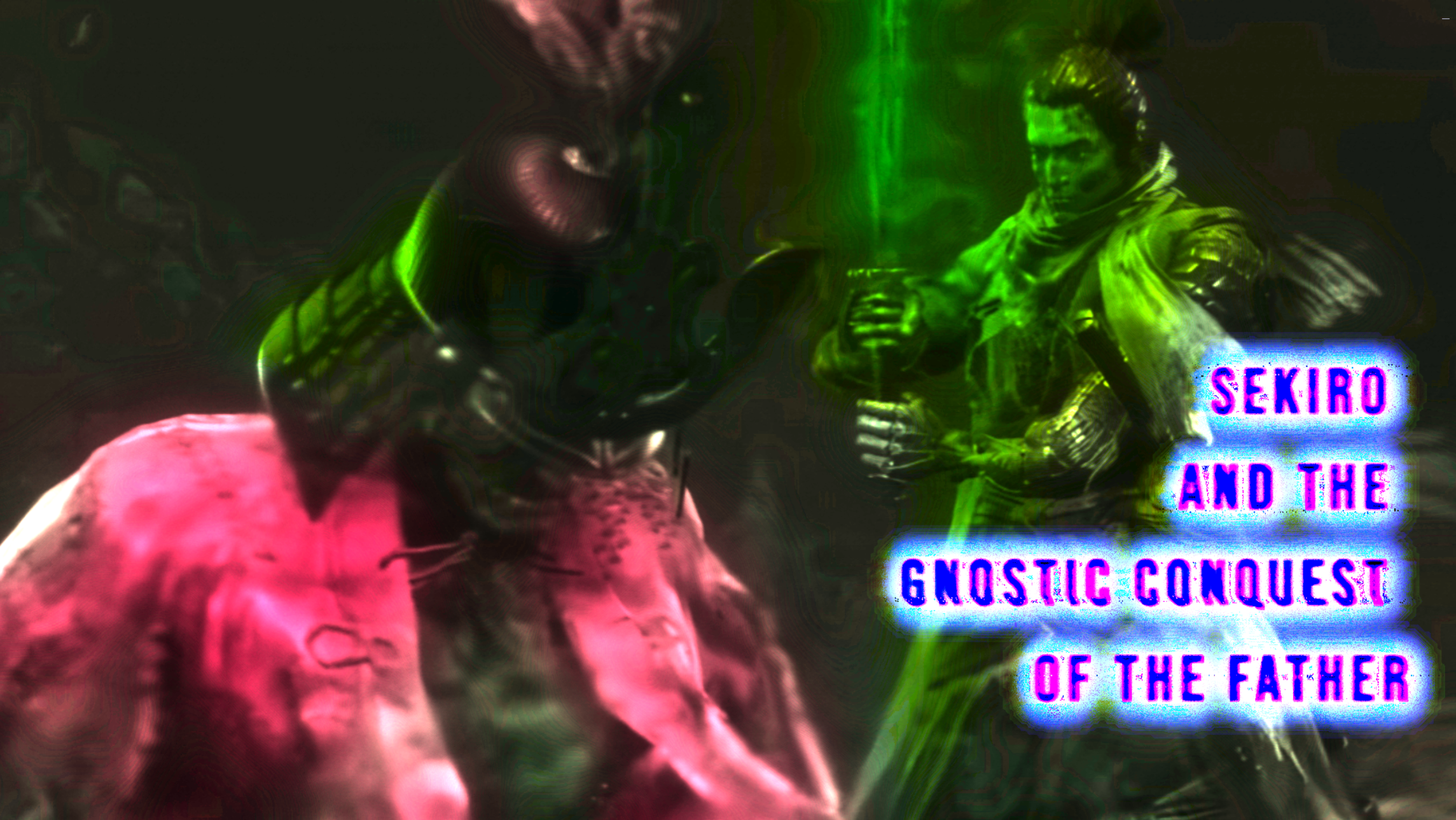
“Hesitation is Defeat“
Few modern interactive experiences strike the exact frequency of male psychology like Sekiro: Shadows Die Twice.
From Software’s masterpiece is a mirror held up to the split father-wound: the tyrant who demands obedience and the dying master who demands you surpass him.
The game forces you to choose.
And then forces you to kill the choice.
Hesitation is defeat, and so is nostalgia.
So is mercy without clarity.
Sekiro does not let you look away.
The Two Faces of the Patriarch
Owl and Isshin
The game, having a more coherent, focused story than From Software’s usual output, does not hand you a single, convenient model of masculinity.
Wolf, and by extension the player, are split between two primal archetypes that every man eventually meets in his own bloodline.
The Great Shinobi Owl
The Shadow of Narcissism
Owl is the architect of Wolf’s enslavement.
He finds a starving orphan on a battlefield and forges him into a weapon. This is done out of pure opportunism.
Love isn’t a word in Owl’s dictionary.
His affection is conditional, chained to the Shinobi Code: a bureaucratic hierarchy designed to keep the son forever beneath the father.
When he reappears at Ashina Castle, he demands Wolf betray Kuro and return to obedience.
His “love” was always a leash. His “lessons” were always a form of brainwashing.
Mechanically, Owl’s fight is betrayal incarnate: input-reads, poison, firecrackers, shurikens IE. every “dirty” trick that breaks the martial dignity of a fair duel. Beating him is about surviving the system that was built to make you fail. The usual reliance on intuition and the rhythms of battle do not apply here.
He even ends the fight with the line:
Thats…My boy…
His words are the last gasp of the narcissist father, attempting to claim ownership even as the ownership itself is demonstrated as destructive, ephemeral and ultimately meaningless.
Isshin Ashina
The Saint of Martial Dignity
Isshin is the anti-narcissist.
The strongest being in the lore, he is nevertheless dying, consumed by an unnamed illness.
He’s an ancestor-ghost being eaten by time and regret.
In his final days he shares sake, teaches the Ashina Arts (whose only rule is “to win”), and equips Wolf without demanding worship.
His final form, the Sword Saint, is summoned against his will. His aggression, sourced from malice by most of the game’s enemies, is instead the inevitable result of pure ontological necessity.
He fights you because his grandson Genichiro’s dark self-sacrifice forces the issue, and because he respects your agency enough to command you to surpass him.
His last words — “Do it!” — are the ultimate paternal validation:
I have taught you all I can. You are ready.
The Prosthetic and the Wound
Not long after the intro, after Genichiro (Isshin Ashina’s grandson) severs Wolf’s arm, the Sculptor (yet another father figure discussed below) fits him with the Shinobi Prosthetic.
This is the visible scar of the first betrayal made useful.
Every flame vent, every loaded axe, every immortal severence is inherited violence turned back on the world.
The game is teaching the Gnostic move: the Demiurge’s tools can be seized, and your wounds weaponized – but only if you refuse to let the wound define you.
The Gnostic Hero’s Journey
Out-Ghosting the System
Sekiro is a Gnostic myth dressed in steel and snow.
Wolf begins as a tool: a simple, hopeless wolf with no will, raised by a violent narcissist and bound by a Code. The entire campaign is the acquisition of gnosis: mastering the parry, decoding the Rejuvenating Waters, healing the Dragonrot, and understanding that immortality itself is the ultimate corruption.
The emotional apex, rather than resulting from an Elden Ring-styled “boss rush”, is the final, stationary decapitation of Sword Saint Isshin.
In the unfortunately most-popular soulslike games, you roll frantically through an empty arena (hello, Elden Ring), chased by monstrous gymnasts with amphetamine problems.
Sekiro: Shadows Die Twice, on the other hand, is the ultimate distillation of From Software’s prior work.
Isshin, after an impossibly long and brutal battle – requiring the player’s mastery of complex mechanics under immense pressure – drops to his knees, surrenders to his fate, finally secure in the knowledge that his Ashina Arts have been passed on to a worthy successor – and commands Wolf to finish the job:
“DO IT!”
In Sekiro the camera locks, the music drops to silence, and Wolf speaks the line that many men will never get to say to their father figures of yesterday:
“…Farewell.”
Isshin has become a prisoner of his own legend, of a glory-age ghost who cannot let go of the cursed world he knows he helped build.
By giving him the final, warrior’s death befitting of a master, Wolf is deconstructing the hierarchy.
Hours of intensity and tension collapse to zero.
The fatal system error is corrected.
Katabasis
The Mercy of the Controlled Exit
This is Sekiro’s intellectual katabasis (a hero’s descent into the underworld).
Many men have lived this in real life: the “ghost-mentor” taken by death, distance, or cancer before the final lesson could be completed.
The jealous father still lingers.
The intellectual soul departs far too soon.
Sekiro hands you the Black Mortal Blade and says:
Finish it cleanly.
The ten-minute crescendo with Sword Saint Isshin is a metronome of clashing steel.
You internalize the rhythm, master nature itself in the form of the absorption and the delivery of strikes of literal lightning, and then deliver the mercy stroke.
You cannot save the dying father in reality.
Here, the decapitation is a hard cut to silence: respectful, professional, dignified, and deserved.
It restores martial dignity to both mentor and successor.
The Sculptor as Living Warning
Before the endings, the game gives you the Sculptor, the ghost who failed halfway.
Once a shinobi like Wolf, he could not sever the immortal tie.
He became Shura.
Now he sits carving Buddha statues, trying to atone with art for the violence still burning in his veins.
He is the half-life that awaits any man who refuses the final cut: endless penance without release.
The Fork in the Road
Shura vs. Severance
The Shura Ending
Triumph of the Narcissist
Obey Owl.
Murder Emma.
Kill the fire-wielding, aged Isshin.
Wolf, by the end of this hopeless path of surrender, looks like an aging drug addict instead of a triumphant warrior.
In this ending, he chooses the repetitive, destructive suffering of the narcissist father.
Owl seizes power, only to be backstabbed by his own tool: Wolf himself.
The cycle wins.
The son remains a slave.
The Return Ending
Mastering the Mandate
Reject the Code.
Decapitate your origin in the Hirata memory.
Defeat Sword Saint Isshin with composure and respect.
Wolf becomes the vessel for the mentor’s techniques.
The journey ends in the calm, stationary responsibility – built on immense sadness – of carrying the sacred mandate forward.
The Real Wound
Every man who grew up with an Owl knows the exact moment conditional love flipped to betrayal.
Every man who lost an Isshin too early knows the ache of
“I never got to show him I surpassed him.”
Sekiro gives us the dignity of performing the mercy kill in simulation so that the real wound stops bleeding quite so profusely.
It is shadow work disguised as a video game.
Mastering the Hand Dealt
Sekiro might look like it’s about winning, but at a deeper level it’s about dignity in the face of inevitability.
It rejects the endless-build-variable “content mall” of later FromSoftware games (*cough* why is Elden Ring the most popular one, for Christ’s sake *cough*) and replaces it with axiomatic certainty.
It maps the complex geometry of fatherhood and mentorship, then demands you find the rhythm inside the noise.
The chill that runs through the player when Isshin drops to his knees is the sound of the last chain breaking.
The system has been out-ghosted.
The pulse is now the player’s.
Hesitation is defeat.
Composure is inheritance.
-BU