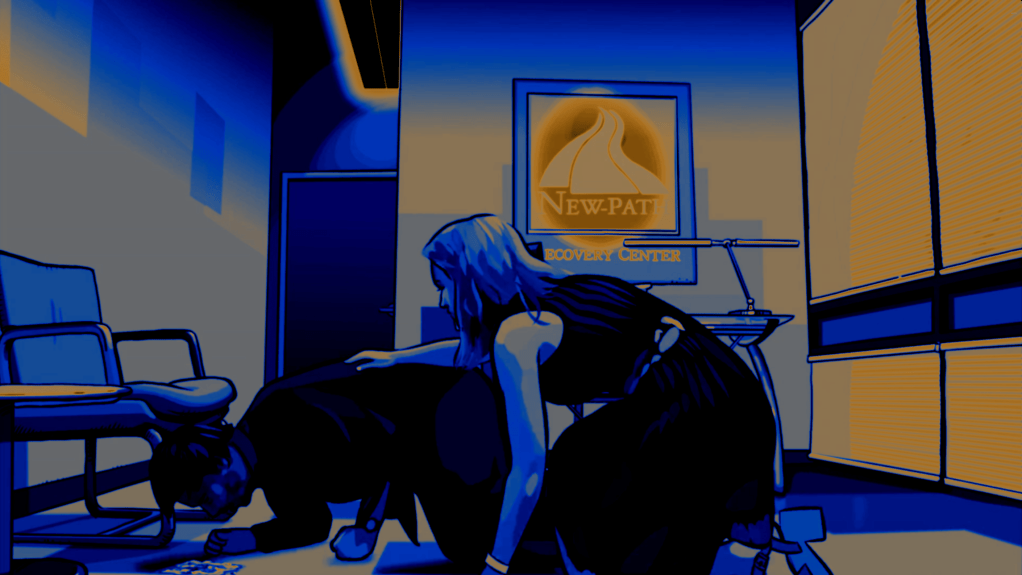
In the United States today, the “War on Drugs” infuses everyday life with punitive logic, casting a long shadow over health and honesty. Citizens who use substances – legal or illegal – face potential criminal charges, social stigma, and even loss of family.
Under this regime, admission of any drug use to a doctor, employer, or school can trigger surveillance or punishment.
For example, as one public-health analysis notes, mandatory drug testing in prenatal care and the threat of child-welfare intervention often drive pregnant people to avoid all care rather than risk a “fear of punishment and family separation”. In this climate of fear, individuals learn to self-censor: to hide pain and coping strategies from those who might help them.
The result is that the suffering they carry is distorted or lost as it moves through medical and social institutions.
Consider the case of an anonymous young person (we’ll call them “the patient”) seeking treatment for anxiety and despair.
This patient comes from a conservative family and has experimented with psychoactive substances to cope with trauma. Terrified that honest disclosure will bring police involvement or parental wrath, they lie about their drug use during a psychiatric evaluation.
Stripped of the context of self-medication, their symptoms – panic attacks, sleepless nights, emotional numbness – appear endogenous. The psychiatrist, unaware of the hidden substance use, diagnoses depression or a personality disorder and prescribes psychotropic medications.
In short, trauma and coping have been recoded as illness.
This scenario, though particular, exemplifies a growing pattern: under drug prohibition, honesty is dangerous and lies become survival. Over time, the patient’s “self-treatment” is labeled pathology, captured by the psychiatric system rather than addressed at its root.
The Drug War’s Disciplinary Logic
The War on Drugs has spun a web of surveillance that extends far beyond law enforcement.
A recent commentary describes a pervasive “drug war logic” operative in schools, workplaces, and healthcare: mandatory drug reporting, urine testing, background checks, and even zero-tolerance housing rules have made nearly everyone a potential enforcer. In effect, police are only the most visible agents of a system that deputizes doctors, nurses, teachers, and even neighbors as informants. As one study summarizes:
- In the name of “protection,” healthcare and social services now treat any hint of substance use as suspicious. Mandatory tests and reports (to child-welfare authorities, for example) make patients fearful and reluctant to seek care.
- Pregnant people, in particular, often delay or skip prenatal visits rather than admit to drug or alcohol use, since in many states even a positive test alone can lead to a foster-care investigation.
- Crucially, medical records betray patients. A positive toxicology ends up in the electronic health record, where it can be subpoenaed by courts, accessed by future providers, or trigger mandated reports without the patient’s knowledge.
These measures operate like Foucauldian surveillance: subtle, ever-present, and justified by “health.”
But as one analysis observes, they undermine trust and care. Far from helping patients, mandatory testing and “zero-tolerance” policies often deter people from honest communication and regular treatment. In short, the drug war’s warping of institutions enables secrecy.
When every doctor or social worker is effectively an enforcer, individuals learn to conceal any deviation. What Foucault called the “disciplinary” power of institutions is here turned inward: patients self-police to avoid punishment, even if it costs their health.
Concealed Use, Hidden Data, and Misdiagnosis
Hidden substance use fractures the diagnostic process.
Psychiatry assumes accurate histories; in practice, fear ensures many histories are false. Empirical studies reveal how dangerous this can be.
In one psychiatric-day program, clinicians relying on interviews diagnosed drug problems in only 34% of new patients, yet objective measures (self-reports plus urine toxicology) revealed 69% were actually misusing substances. In other words, more than twice as many patients were using drugs than clinicians realized.
Those cases of concealed use mattered: patients identified as misusers were more likely to leave treatment early, whereas the DSM diagnosis itself had no predictive power.
Simply put, the official diagnoses missed most substance problems, masking the true cause of suffering.
What drives this discrepancy is the self-censorship of patients.
Research shows that self-report screening “is susceptible to patients’ ability and willingness to disclose illegal and/or stigmatized behaviors”. In practice, even sophisticated questionnaires fail to identify a quarter to a half of substance users who are eventually detected by more rigorous methods.
The chart is clear: when patients hide drug use, clinicians see only the surface symptoms.
Anxiety, mood swings, sleep problems – sometimes induced or worsened by withdrawal or toxin exposure – become labeled as primary mental illness.
The War on Drugs has therefore skewed psychiatric statistics and knowledge.
As one author warns, the “propaganda” of prohibition is so ingrained in substance-use research that beneficial effects of some drugs are under-explored and the harms of stigma are undercounted. By treating all use as pathological, the official data become self-fulfilling: hidden use goes uncounted, while incidental distress is classified as endogenous disease.
Psychiatry’s Capture: Pathologizing Coping
The result of this data distortion is institutional capture.
Psychiatry steps into the gap left by undisclosed substance use, often expanding its own diagnoses to fit the symptoms. Complex reactions to trauma and stress are relabeled as “chemical imbalances” or chronic psychiatric syndromes.
Heavy drinking becomes “bipolar disorder,” panic after drug crashes becomes “panic disorder,” and exhaustion from all the concealment becomes “chronic fatigue” or “attention deficit.” In effect, covert coping becomes a cash cow for the psychiatric-industrial complex.
Instead of therapies that address past abuse or community support, the patient receives a pill regimen and a “disorder” tag in their record.
This process has a historical parallel: Ronald Laing’s mid-20th-century study of “schizophrenic” families revealed that the identified patient was often the only relatively sane one in a highly dysfunctional family system.
Laing argued that schizophrenia diagnoses often serve as a scapegoat, obscuring collective family pathology. Today, the War on Drugs adds a new dimension: families and individuals under threat of legal action may unknowingly manufacture their own scapegoats.
The patient who shouldered the secret pain of trauma and addiction now carries the label of “mentally ill.”
From an economic standpoint, this is convenient.
Decades of research document a massive expansion of psychiatric categories.
One analysis notes that lifetime rates of DSM-defined disorders jumped from ~32% to ~48% within ten years in the 1980s, largely due to broadening definitions.
We are edging toward a world in which almost anyone can be labeled disordered at some point. These newly defined “patients” fuel a lucrative industry: pharmaceutical companies, insurance reimbursements, and specialized clinics all profit when emotions are rebranded as diseases.
Indeed, the very term “psychiatric-industrial complex” has emerged to describe how psychiatry and Big Pharma co-opt suffering into economic data.
Allen Frances and colleagues, key figures in DSM reform, warned that DSM‐5 was poised to create tens of millions of new patients and thus millions in revenue for drug-makers.
In practice, then, the pretense of “treatment” often masks administrative expedience: bureaucracy classifies people to manage them, rather than to heal them.
Theoretical Lens: Power, Family, and Trauma
These dynamics have deep intellectual roots.
Michel Foucault described modern society’s “governmentality” and “biopower” – the subtle social controls exercised by institutions. The War on Drugs exemplifies Foucault’s “disciplinary” mechanism: by medicalizing deviance, society punishes drug use through therapy rather than jail, but the aim is control, not compassion.
As Foucault wrote, psychiatric and penal systems often merge into a single apparatus of normalization. Drug treatment courts, for instance, have been analyzed as embodying a Foucauldian “therapeutic discipline” – they normalize offenders through constant surveillance and self-regulation.
In effect, the patient under suspicion is never free to speak the truth; power operates through the fear of being unmasked as deviant.
R.D. Laing’s insights remind us to question the locus of pathology.
He and his colleagues found that no “schizophrenic” patient he studied came from a normal family environment. He would say our society often brands the wounded one as insane to avoid confronting the sickness of our relationships.
Likewise, Gabor Maté notes that addiction is not a moral failing but a response to pain – “the question is not why the addiction but why the pain.”
In the current system, however, psychiatry usually answers that question with a brain scan, not a support group.
Childhood abuse, poverty, and systemic injustice get translated into neurotransmitter deficits on the side of a billing form.
This diagnostic reductionism – treating complex lives as biomedical malfunctions – serves ideological functions. It individualizes problems, reinforcing narratives of personal responsibility and innate pathology.
A neoliberal order thrives on such rhetoric: when the broken are people’s brains instead of broken systems, the state is absolved. Moreover, calling someone “mentally ill” stigmatizes them as different and powerless, which conveniently discourages protest and absolves families or society of guilt.
The irony is that the very policies producing the despair (economic precarity, racialized policing, social isolation) are left out of the picture. As one commentary notes, neoliberal policies have created a cascade of “deaths of despair” and mental distress, yet the response has been more medicalization and medication rather than addressing root causes.
Administrative, Economic, and Ideological Functions
Thus, the psychiatric labels imposed under the drug war do work other than healing.
Administratively, diagnoses justify surveillance: insurers demand codes, schools demand paperwork, agencies demand clearance. Diagnosing a hidden substance user with a stable illness allows parents, employers, and courts to believe the problem is fixed or at least categorized, while it quietly remains concealed.
Economically, each diagnosis generates funding – insurance payouts, prescription profits, research grants – that may depend on keeping prevalence numbers high. And ideologically, the system projects the war’s logic onto individuals: the drug war demands victims be visibly sick or criminal, and psychiatry obliges by converting dissent or pain into disorder.
We have examples from history: in Soviet Russia, psychiatry was used to label dissidents as mentally ill.
In our context, the dissidence is subtle – resisting prohibition or confessing to drug use is seen as deviance. By labeling it as illness, the system pretends to care even as it punishes.
A brave honesty about drug use would break that spell, but such honesty is exactly what is silenced.
The Voice of Truth
The U.S. drug war has unwittingly engorged the psychiatric-industrial complex.
Fear of legal or familial reprisal drives people into secrecy, warping the truth of their condition. Psychiatry, with its expanding manuals and pill-driven treatments, then stands ready to interpret those secret struggles as lifetime diseases, often untreatable and ticketed.
Power flows seamlessly: institutions get their diagnoses, professionals get their patients, and the biopharma market gets its consumers.
What gets lost is healing.
The patient’s real needs – understanding trauma, building community, having honest support – are sacrificed to maintain an illusion of control and to perpetuate an ideology.
A truly healthy society would replace threats of jail and separation with compassion and decriminalization, so that truth is safe.
Only then would psychiatry serve to heal rather than to hustle, and people could speak their pain without fear of judgment or punishment.
-Brett W. Urben
Sources: Evidence and arguments above are drawn from recent research and theory. For instance, the hidden rate of drug misuse in psychiatric patients is documented in a study finding 69% undisclosed use. Analyses of U.S. “drug war” policy detail how mandatory drug testing and reporting deter honest medical care. Scholars like Stone explicitly warn that drug-war ideology biases addiction research toward propaganda. Critics of psychiatry (e.g. Laing) and analyses of the DSM reveal how family dynamics and medicalization shape diagnoses. These sources show that under our current regime, diagnostic categories often serve surveillance and profit more than genuine understanding or relief.
How the war on drugs impacts social determinants of health beyond the criminal legal system – PMC
https://pmc.ncbi.nlm.nih.gov/articles/PMC9302017/
Undiagnosed Drug Misuse among Admissions to Psychiatric Day Treatment and Prediction of Early Exit – PMC
https://pmc.ncbi.nlm.nih.gov/articles/PMC3527836/
The War on Drugs has Unduly Biased Substance Use Research – PubMed
https://pubmed.ncbi.nlm.nih.gov/36537205/
Massive | ResearchGate
https://www.researchgate.net/publication/305521530_Massive
Holding the Line against Diagnostic Inflation in Psychiatry
Therapeutic Discipline: Drug Courts, Foucault, and the Power of the Normalizing Gaze by Michael D. Sousa :: SSRN
https://papers.ssrn.com/sol3/papers.cfm?abstract_id=3704029
Mental Health Challenges Related to Neoliberal Capitalism in the United States – PMC
 Gnosis Under Fire