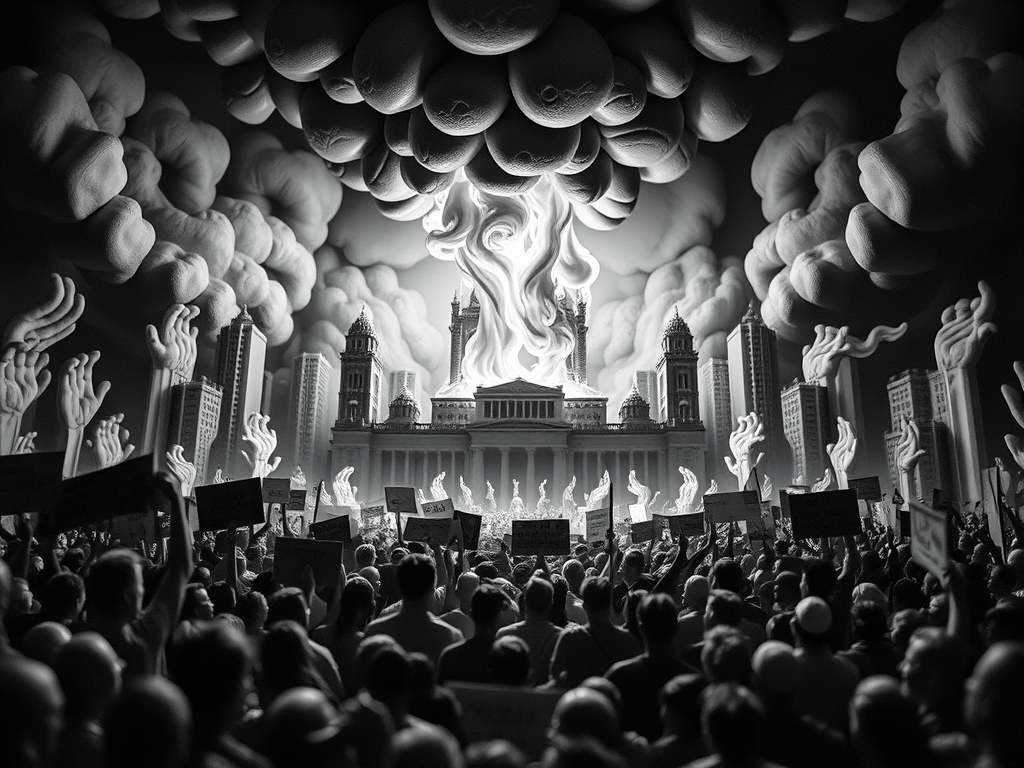
In today’s media ecology, tech giants have seized control of culture’s dials and switches.
Platforms like Alphabet (Google/YouTube) and Spotify now decide what is heard and seen: one study notes that YouTube’s engine “drives approximately 70% of views”, meaning algorithms – not audiences – curate our experience.
Critics warn this has exacted a profound toll. A UK government review reports that streaming algorithms “reflect biases that may subsequently reduce new music discovery, homogenise taste and disempower self-releasing artists”.
In plain terms, the same names keep winning while deeper wells of diversity run dry. Music recommendation systems now tend to “reinforce prior preferences,” creating filter-bubbles of “reduced musical diversity” and “increased taste tautology”.
In effect, digital playlists reward the familiar, endlessly echoing back pre-approved sounds.
This algorithmic control is cloaked in corporate machinations. Major labels and streaming services strike backroom deals to game the system: in 2020 Spotify even offered labels the ability to pay for playlist “promotion” in its algorithms.
And studies find that the prized “Big Playlist” slots (think Spotify’s Rap Caviar or Today’s Top Hits) are overwhelmingly filled with major-label artists, shutting out independent creators. As one submission to the UK inquiry put it, platforms “skew everything in favour of the artists who exist at the top of the pyramid”, ensuring the mainstream remains sterile and self-referential.
The result is a feedback loop of aesthetic homogeneity: as one analysis notes, recommendation engines have “reduced musical diversity” by churning out rehashed formulas.
Each track’s creative risk is blunted by the algorithm’s instinct to play it safe.
It’s no accident that our playlists now resemble fast food menus of sound – seasoned only to appeal universally. Users may believe they’re discovering something fresh, but in truth the choices are pre-ordained.
Research on YouTube makes this plain: the platform “automatically plays further videos that its recommender system deems to be of interest”. In other words, YouTube effectively curates the next video for you.
Moreover, one study found that fully one-third of the first 500 videos shown to a new user were low-quality “AI slop” – synthetic content pumped out to farm views.
Even when platforms feign a democratic “for you” feed, the deck is stacked: algorithms preferentially amplify trending tropes, and human whims barely register.
Symbolic Laundering: Pop Icons and Cultural Plunder
This corporate-algorithm nexus ties directly into how “culture” is packaged.
Pop stars like Harry Styles or Diplo become avatars of a sanitized pluralism – they act like champions of real subcultures, but instead launder them.
Harry Styles, draped in pastel suits and headdresses, serves as a candy-coated appropriation of diverse aesthetics. One critic notes that when Pharrell Williams or Styles donned Native American warbonnets, they “contributed to the reductive image of the Indian…a stereotype that groups together every distinct tribe under one purely aesthetic cultural symbol”.
The difference between genuine heritage and costume blurs into a mere fashion accessory.
Styles’ celebrated androgyny or diplo’s globetrotting EDM collabs are sold as “diverse,” yet they’re curated to be as risk-free as possible – market-friendly gestures that flatter multiple audiences without truly empowering any.
Diplo himself acknowledges this uneasy dance: he quipped that “being a white American, you have zero cultural capital” in the very genres he exploits.
And yet he’s built a career re-packaging dancehall, reggae, Afrobeats and Latin grooves into slick pop hits for global charts. In this system, loud claims of progressiveness often mask a deep conservatism: a song will hint at social awareness only if its chords and beats could just as easily come from a toothpaste ad.
The interplay of race and genre has been flattened into a colorless palette.
Icons like Styles or Diplo gain kudos for “inclusivity,” but their brand of inclusivity is entirely aesthetic and atomized – ever safe, ever upbeat.
It’s symbolic laundering: complex cultures are scrubbed clean of politics or pain, then presented as palatable platitudes.
This is why mainstream lyrics often ring hollow.
Consider the vapid pep of many chart hits: refrains like “Feel the moment, let it take you over” or endlessly repeated choruses about sunshine and dance are engineered to go down easy, not to stand up and challenge.
Unlike true art, which risks contradiction and ambiguity, these songs cycle between a few predictable motifs.
They have no “difference that makes a difference.”
In Belfiore’s words, we’ve become stuck in “an unfruitful horizontal process of infinite recombination of inventions, most of them long established and having lost any capacity to create an ‘event’ ”.
Every new hit is just a remix of something old – a sterile feedback loop.
AI and the Manufacture of Ubiquity
Behind the scenes, artificial intelligence and bots have accelerated this hollowing out.
Fraudulent streams and synthetic views mean popularity itself can be bought or faked.
A 2025 class-action suit alleges that Spotify “turned a blind eye” to bots that pumped up Drake’s 37 billion streams, diverting royalties to the wrong parties.
Court filings estimate that Spotify has paid out “hundreds of millions of dollars” to unfairly boosted tracks, hampering independent artists.
Spotify publicly claims it combats fake streams with algorithms of its own, but the scale is staggering: industry insiders tell The Guardian that fraudsters are unleashing AI-generated songs by the tens of thousands each day, then using click farms (bots or low-paid workers) to replay those songs endlessly.
Deezer reports 18% of daily uploads are fully AI-composed tracks – nearly a fifth of every new song – created merely to skim royalty scraps.
YouTube, too, has become awash in algorithmic noise.
An analysis by video experts found that 20–30% of videos pushed to new users on YouTube are nothing but “AI slop” – low-grade, auto-generated animations cooked up to snag views.
Remarkably, Kapwing’s data showed 278 such faceless channels amassed 63 billion views and some $117 million in ad revenue.
These meme-porn channels (featuring things like brawling cartoon monkeys or robotic pets) are engineered to be endlessly clickable: their absurdity hooks viewers until the AdSense cash register rings.
One might think YouTube would clean up this mess, but even as Google vows to curb “inauthentic content,” the AI sluice continues to pour in.
And this isn’t only confined to music.
Across social media, armies of automated accounts manufacture consensus.
As Fast Company reports, “bot farm amplification is being used to make ideas on social media seem more popular than they really are”.
Racks of phones and fake profiles can upvote or share a post into the trending bin – “making people believe those lies are true”.
In practical terms, one can buy a viral trend: celebrities’ PR teams farm engagement to propel bland content up the charts, and geopolitical actors doctor narratives by massaging the algorithm.
The end result is a world where your feed may show 10 news headlines or hit songs, but in reality those were lit up by hidden hands.
Postmodern Feedback and the Death of Artistic Risk
Viewed from this height, culture looks more like a simulation than a conversation.
Philosophers of late capitalism have warned that the market is “a substitute for itself,” endlessly recombining its own symbols until difference evaporates.
In the vocabulary of Gnostic and ontological thought, this is a triumph of numbers over meaning: art reduced to data points for infinite remix.
Each new track or video is simply another permutation in a feedback loop, not an act of genuine becoming. As Belfiore argues, we lack “any capacity to create an ‘event’ ” – real moments of change – because the system rewards only what it has already seen.
Every ostensible innovation is pre-chewed by algorithmic criteria for safety and shareability.
The casualty is artistic risk.
In a world of zero resistance, creators learn fast that anything truly provocative will be filtered out or censored.
Even expressions of dissent are instantly commodified: postmodern media teach us to smile no matter how bitter the pill.
Subcultures that once fought the mainstream are now museum pieces, quickly absorbed by the “streaming-industrial complex.” The critic Franco Berardi warned that digital culture has invented a new alienation: the algorithmic man, who is “free to choose” among countless options, yet trapped in a vortex of sameness.
This platformized reality manufactures consent rather than inspiring challenge.
We are invited to wake up and see the gears turning – to refuse the passive trance of “infinite recombination.”
The sources are clear: major platforms’ own leaks and studies show that without transparency and oversight, we are at the mercy of coded curation.
Awareness is the first step toward change.
If culture is indeed being reinvented by profit-driven formula, then critique itself must become an art.
To break free, we must demand algorithms that serve difference, not stifle it.
-Brett W. Urben
Sources: Independent reporting and research reveal these dynamics. Government inquiries note algorithmic bias and paid-playlist schemes.
Investigative journalism documents streaming fraud and AI bots robbing artists. Academic analyses warn of filter bubbles and homogenized tastes.
Together they paint an urgent picture: a cultural crisis of our own making. Each citation below is a call to look beyond the sanitized feed – to reclaim real art from the algorithms.
Examining the Impact of YouTube’s Video Recommendation Algorithm on Pro- or Anti-Tobacco Messaging | Nicotine & Tobacco Research | Oxford Academic
https://academic.oup.com/ntr/advance-article-abstract/doi/10.1093/ntr/ntaf218/8305108
The impact of algorithmically driven recommendation systems on music consumption and production – a literature review – GOV.UK
(PDF) Effects of algorithmic curation in users’ music taste on Spotify
Systematic review: YouTube recommendations and problematic content – PMC
https://pmc.ncbi.nlm.nih.gov/articles/PMC7613872/
More than 20% of videos shown to new YouTube users are ‘AI slop’, study finds | AI (artificial intelligence) | The Guardian
Pharrell, Harry Styles, and Native American Appropriation
Diplo: ‘Being a white American, you have zero cultural capital’ | Diplo | The Guardian
Raphaël Belfiore – What is new music for ? A schematic answer — post-music post
https://post-musicpost.net/rapha%C3%ABl-belfiore-what-is-new-music-for-a-schematic-answer
Spotify Failed to Act on Bot-Farmed Drake Streams, Class-Action Lawsuit Alleges | Pitchfork
AI, bot farms and innocent indie victims: how music streaming became a hotbed of fraud and fakery | Music streaming | The Guardian
Bot farms invade social media to hijack popular sentiment – Fast Company
https://www.fastcompany.com/91321143/bot-farms-social-media-manipulation
 Gnosis Under Fire