
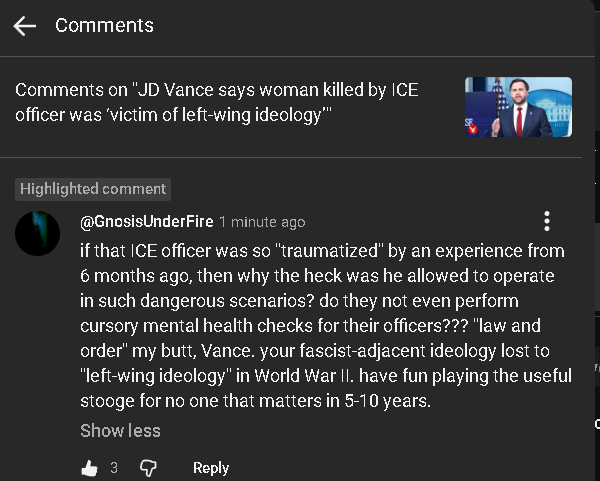
There’s a specific kind of modern propaganda that doesn’t feel like propaganda because it doesn’t sound like a slogan.
It sounds like a bureaucrat clearing his throat.
It sounds like “context.”
It sounds like “complicated.”
It sounds like “tragic.”
It sounds like a person with a carefully manicured haircut reading from a script and calling it moral seriousness.
And the reason it’s effective is because it doesn’t ask you to believe anything heroic.
It asks you to accept something ordinary: that when power harms someone, the harm can be converted into narrative, and the narrative can be sold as explanation.
If you want the cleanest test for whether you’re watching explanation or excuse, here it is:
If the justification collapses under its own logic, it was never meant to clarify reality.
It was meant to protect a system.
The rhetorical crack in this specific framing is almost embarrassingly obvious.
It goes like this:
If an officer was so deeply “traumatized” by an incident six months prior that it explains (or mitigates) catastrophic behavior now… then why was that officer still operating in dangerous scenarios?
That isn’t a “gotcha.”
That’s literally how safety works in any competent domain.
Aviation.
Medicine.
Heavy machinery.
The military, on paper.
Any field where a single lapse can kill someone.
We don’t treat psychological fitness as a decorative afterthought.
We treat it as part of the job — because otherwise the job becomes a roulette wheel and the public becomes the ammunition.
So when someone tries to play the “trauma card” only after a person is dead, it’s not compassion.
It’s a tactic.
It’s the moral equivalent of a firefighter showing up after the house is ash, then handing you a pamphlet about how flammable wood is.
And here’s where Hannah Arendt strolls into the room, not as a meme (“banality of evil lol”) but as an operating principle:
Arendt’s point wasn’t that evil is small.
Her point was that evil often wears the face of normalcy, the voice of procedure, the tone of someone “just doing their job,” someone who doesn’t feel like a monster — because they’ve outsourced their conscience to the system.
The modern version isn’t a Nazi clerk stamping train manifests.
It’s the press-release voice that turns a dead civilian into a rhetorical object and then calls that object an “ideological victim.”
That is the banality: the conversion of human reality into administrative narrative.
Now, the second trick is nastier: the scapegoat.
“Left-wing ideology.”
This phrase is the perfect ideological solvent.
It dissolves accountability.
It does a magic trick where the actual chain of causality — training, policy, screening, supervision, force doctrine, mission design, rules of engagement — evaporates into a vague phantom called “ideology,” and the phantom is always conveniently located somewhere far away from the institution itself.
It’s not meant to be true.
It’s meant to be useful.
This is why Arendt keeps getting validated by every stupid press release: the content is less important than the form. The form is always the same:
- something horrific happens
- the institution reflexively protects itself
- the spokesperson frames the horror as a tragic exception
- the exception is blamed on a cultural enemy
- the cultural enemy becomes the “real” story
- the system walks away with its legitimacy intact
If you’re wondering why this feels like you’re watching a reality show about morality rather than morality itself, congratulations — you’re seeing it.
And it gets worse, because the “mental health” angle is part of the trap.
Here’s the double-bind: mental health is treated as sacred and urgent when it can be used to humanize power after power harms someone… but it is treated as irrelevant, optional, or nonexistent when it would require preventive accountability inside the institution.
So “trauma” becomes a shield, not a trigger for safety protocols.
This is one of the grossest rhetorical hacks of modern governance: the selective activation of compassion as a PR device.
A grief-shaped coupon.
It also contaminates the entire public conversation about mental health, because it teaches people that “mental health” is not a real standard applied consistently — it’s a narrative lever.
That’s not compassion; it’s cynicism wearing empathy like stolen clothes.
Now zoom out.
This isn’t just about one official statement.
This is about a bigger pattern:
A political culture that treats the public as a story-consumer rather than a citizenry.
Your job isn’t to understand.
Your job is to feel the correct feeling at the correct time toward the correct designated enemy.
The details don’t matter.
The vibe matters.
And once your politics becomes vibe-management, it becomes extremely easy to weaponize.
The scapegoat phrase (“left-wing ideology”) isn’t just wrong; it’s structurally dangerous, because it rewires the public brain to associate state violence with “necessary response to ideological threat.”
That’s how you get permanent exception.
Permanent emergency.
Permanent permission.
The state is always “responding” to something — which means it never has to be judged on its own design.
This is where the ideology machine becomes self-consuming:
It creates fear, then sells fear as justification, then cites the fear as evidence that more force is needed.
It’s a feedback loop.
A closed circuit.
A snake eating its own legitimacy and calling it patriotism.
And that’s the part that should terrify anyone who claims to love “law and order”: because the moment “order” becomes a narrative rather than a standard, law becomes theater.
At that point, “law and order” doesn’t mean consistent rules applied to everyone.
It means protection for the in-group, exposure for the out-group.
It means the right people get excuses and the wrong people get blame.
It means violence can be laundered into righteousness with a press release and a camera.
It demands what propaganda is designed to prevent:
a coherent causal chain.
If someone is unfit, why were they deployed?
If screening exists, why did it fail?
If “trauma” is real, why wasn’t it treated seriously before someone died?
If ideology is the problem, why does the institution keep producing the same outcomes?
Those questions aren’t partisan.
They’re adult.
And if the system can’t answer them, then what you’re watching isn’t governance.
It’s stagecraft.
The real Arendt vibe isn’t despair.
It’s clarity: evil doesn’t always announce itself with horns.
Sometimes it shows up in a well-lit studio, with a polished talking head, telling you that the real victim is an ideology.
No.
The victim is a person.
And the public doesn’t need more stories.
It needs accountability that works before the body count.
-Brett Urben
 Gnosis Under Fire
You must be logged in to post a comment.